
A tree in Peoria should be removed when it is dead, dying, or dangerous — for example, a hollow trunk, a sharp lean after a storm, or roots lifting your driveway. If the tree threatens your home, your family, or nearby power lines, taking it down is the safe choice.
In Peoria, IL, professional tree removal typically costs between $400 and $1,800. Small trees cost less, while large, hard-to-reach, or emergency removals cost more. Any honest company will give you a free on-site estimate before work begins.
Cutting down a healthy tree wastes money — but leaving a dangerous one standing can cost far more. Here is how to tell the difference.
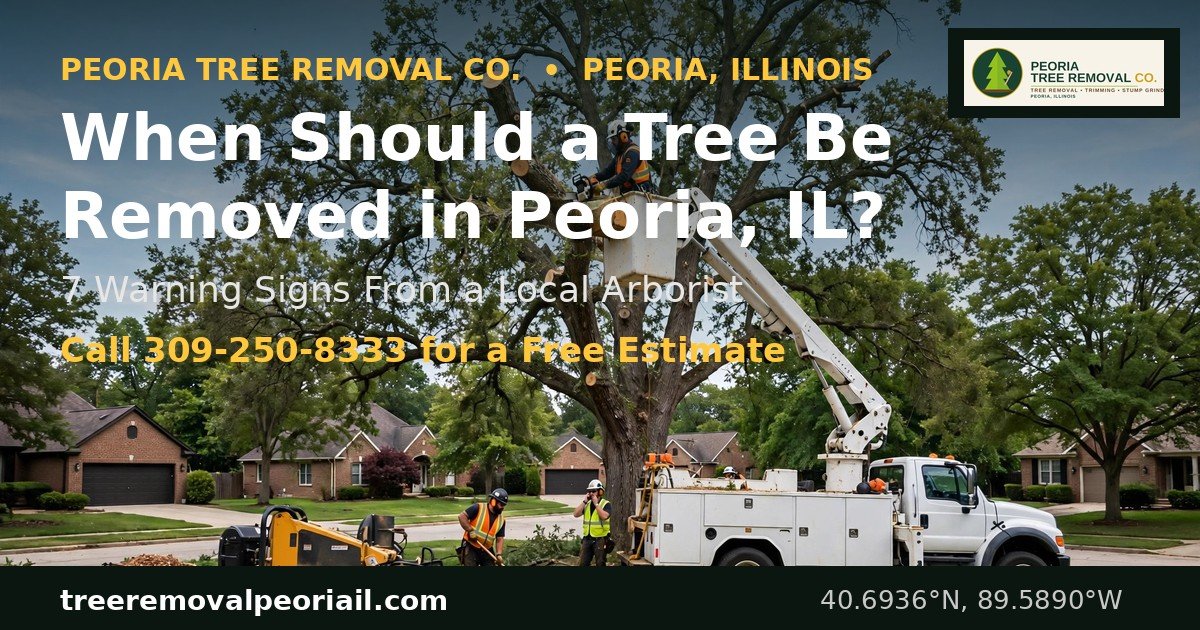
7 Signs It’s Time to Remove Your Tree in Peoria
These are the warning signs I check on every hazardous tree inspection across Peoria County, from Peoria Heights to Morton. One sign means call an arborist for a look. Two or more usually means removal.
1. The Tree Is Dead or Dying
A dead tree is a falling hazard waiting for the next windstorm. Here in Central Illinois, the emerald ash borer has killed thousands of ash trees — I have removed dead ash from yards in the 61614 and 61615 ZIP codes, East Peoria, and out toward Dunlap.
No leaves in summer, bark falling off in sheets, branches that snap instead of bend: the tree is gone and it will not come back. Every month you wait, the wood gets weaker and the removal gets riskier.
2. It’s Leaning Dangerously
A slight natural lean is fine. A new or growing lean — especially after one of our summer thunderstorms — is not. Walk around the base: if you see cracked or lifted soil on one side, the root plate is failing. A tree leaning toward your house or driveway with heaving soil needs to come down before the next storm does it for you.
3. The Trunk Is Hollow, Cracked, or Damaged
Knock on the trunk. A solid thunk is good; a hollow drum sound means decay inside. Watch for deep vertical cracks, large patches of missing bark, and mushrooms growing on the trunk — fungi on wood means rot from the inside out. When roughly a third of the trunk is compromised, no amount of tree trimming will make it safe.
4. The Roots Are Damaged or Lifting Concrete
Roots are the tree’s anchor. Construction or trenching that cuts major roots on one side leaves the tree with no grip — I see this often in older neighborhoods near Knoxville Avenue and Peoria Heights, where trees grow tight against sidewalks. Roots lifting your driveway slabs or soil mounding around the base are red flags. A tree with a failed root system can topple in a mild storm.
5. Large Dead Branches Hang Over Your Roof
Arborists call these “widowmakers.” Big dead limbs over your roof, play area, or parked cars are an accident waiting to happen — and Peoria’s winter ice storms add hundreds of pounds of weight that snap weakened limbs like matchsticks. Sometimes pruning solves it; when most of the crown is dead, removal is the better investment.
6. Disease Has Gone Too Far to Treat
Oak wilt, anthracnose, and cankers hit Peoria maples and oaks regularly, and early treatment by an arborist service can save many trees. But when over half the canopy is dead or the disease has moved through the roots, treatment becomes wishful thinking. Removing it also protects your healthy trees nearby from catching the same disease.
7. It’s Growing Into Power Lines or Your Foundation
A silver maple planted six feet from a house seemed fine in 1985. Forty years later its roots press the foundation and its top tangles the service lines — I see this constantly from Glen Oak Park to West Peoria. When the tree’s location is the problem, removal is usually the only real fix.
When Tree Trimming Can Save the Tree Instead
Many “removals” I get called for turn into trimmings. If the trunk is solid, the roots are healthy, and the problem is just overgrown or crossing branches, professional pruning solves it for a fraction of removal cost. Good candidates: healthy structure with a live crown, a few dead limbs, or young trees needing corrective pruning.
A certified arborist should always check the “save it” option first. If a company jumps straight to “cut it down” without explaining why, get a second opinion.
Peoria Weather: Why Timing Matters
Our June-to-August thunderstorms bring the straight-line winds that topple weakened trees, and winter ice storms snap weakened limbs. I do some of my busiest emergency tree removal work in the 48 hours after a big storm crosses Peoria County.
That is why late fall and winter are the smartest, cheapest time for non-emergency removal: trees are dormant, the ground is firm, and demand is lower. If your tree is hazardous but standing, do not wait for spring storm season. More on this in our guide to the best and cheapest time for tree removal in Peoria.
What Does Tree Removal Cost in Peoria, IL?
Most residential jobs in Peoria fall between $400 and $1,800:
Small trees (under 25 feet, easy access): $400–$700.
Medium trees (25–60 feet): $700–$1,200.
Large trees (over 60 feet, near houses or lines): $1,200–$1,800+.
Emergency or storm work: more, because it is dangerous and urgent.
Price follows access, condition, and risk — not just height. A dead 70-foot oak leaning over a garage near Grandview Drive costs more than the same tree in an open field, because the crew must rig every piece down by hand. See our full breakdowns of cost by tree size, overall tree removal cost in Peoria, and emergency removal pricing.
My 30-year rule: never accept a firm price over the phone from someone who has not seen the tree. Legitimate companies give free on-site estimates.
Do You Need a Permit to Remove a Tree in Peoria?
On private property in Peoria, you generally do not need a permit. Exceptions: designated historic districts, trees on the public right-of-way (the parkway between sidewalk and street), and some protected areas. Surrounding towns like East Peoria, Morton, and Washington have their own rules. Full details here: tree removal permits in Peoria, IL.
What Happens to the Stump?
A leftover stump becomes a tripping hazard and pest hotel. That is why most of our removals include stump grinding — the stump is ground 6–12 inches below the surface and the area is cleaned up, leaving you with usable yard. Comparing your options? Read grind vs. full stump removal and current stump grinding costs in Peoria.
What If a Tree Falls on Your House?
First: get everyone safe, stay out of damaged rooms, and call 911 for injuries or downed lines. Then call a company that does true emergency work. Our step-by-step guide covers exactly this: what to do when a tree falls on your house in Peoria.
The next question is always insurance. If a storm dropped the tree onto an insured structure, it is often covered — see whether homeowners insurance covers tree removal. Photograph everything before cleanup begins.
How a Certified Arborist Makes the Call
On every inspection I run the same risk assessment the International Society of Arboriculture teaches — homeowners can learn the basics at treesaregood.org, and the Morton Arboretum has excellent Midwest tree-health resources.
Trunk: solid, or compromised by decay, cracks, cavities?
Roots: intact, or cut, rotted, lifting?
Lean: natural or new — and what is it leaning toward?
Canopy: how much is alive versus dead?
Targets: house, driveway, lines, play area — or open lawn?
Species: ash in borer territory, for example, is living on borrowed time.
An unhealthy tree in an open field is low risk; the same tree over your bedroom is high risk. “Should this tree come down” is always condition plus what sits underneath it — and that judgment is what you pay a certified arborist for.
A Quick Seasonal Tree Check Any Peoria Homeowner Can Do
You do not need climbing gear to catch most problems early. Twice a year — once in spring after the storms pass and once in fall before winter — walk your property and look at each large tree for five minutes:
Spring check: Did it leaf out fully? Bare sections in May mean dead wood. Look for storm damage from winter: cracked limbs, hanging branches, fresh leaning.
Summer check: After any big thunderstorm, scan for new leans and fallen limbs. Summer is also when fungal growth and insect damage show up most clearly on trunks.
Fall check: Look at the base for heaving soil and at the canopy for thinning. Fall is the ideal time to schedule a professional inspection — and to book winter removal at off-season pricing.
Winter check: With leaves gone, structural problems are easiest to see: crossing branches, cavities, and cracks stand out. Ice building up on already-weak limbs is your cue to act before the next freeze.
Five minutes per tree, twice a year. That habit alone prevents most of the emergency calls I get after Peoria’s big storms.
Related Articles
Frequently Asked Questions
Can I remove a tree myself?
A small ornamental tree far from everything is manageable. Anything taller than your house, leaning, or near structures or lines is not — tree removal is one of America’s most dangerous jobs. The ER bill will dwarf a professional’s price.
How long does removal take?
Most residential jobs take half a day to a full day, including cleanup and stump grinding. Very large or complex jobs can run two days. We give you an honest timeline with every free estimate.
Will you clean up afterward?
Yes — wood cut to manageable lengths, brush chipped, stump ground if requested, and the area raked clean. A company that leaves the mess is not a professional company.
Can a leaning tree be saved?
Sometimes. A young tree with a slight lean can be staked straight. A mature tree with a new, worsening lean and heaving soil cannot be fixed — cabling it just delays the inevitable.
What is the cheapest time of year for tree removal in Peoria?
Late fall through winter, when trees are dormant and demand drops. Summer storm-season emergency work costs the most. If your tree is hazardous but stable, book the off-season.
The Bottom Line
If your tree is dead, failing, or threatening something you care about, do not wait for the next Peoria thunderstorm to decide for you. And if you are unsure, that is what a free inspection is for. At Peoria Tree Removal Co., we have spent 17 years helping homeowners across Peoria, East Peoria, Morton, Washington, and Bartonville make the right call — including plenty of times when the right call was “this tree is fine, leave it alone.”
Call today for a free, no-pressure estimate. We will give you an honest answer, and only recommend removal when it is truly the safest choice.
Listen to This Article
Prefer listening? Hear the full article narrated:
Peoria Tree Removal Co.
(309) 250-8333
info@treeremovalpeoriail.com
https://treeremovalpeoriail.com/
114 W Forrest Hill Ave, Peoria, IL 61604, USA
Tree Service Company
10 Responses