Trees don’t die overnight. They send signals for months or even years before they become dangerous — you just have to know what to look for. As an ISA Certified company with 17 years in the Peoria area, we’ve seen every warning sign there is, and we’d rather you call us early than call us after a limb lands on your garage.
This guide covers the early warning signs of a dying or diseased tree, plus a special section on emerald ash borer — a pest that’s already confirmed in Peoria County and killing ash trees all over Central Illinois.
7 Early Warning Signs Your Tree Is in Trouble
1. A thinning or sparse canopy. If your tree’s crown looks noticeably thinner than it used to — light coming through where it didn’t before — that’s the tree struggling. Compare it to neighbors’ trees of the same species; the difference is usually obvious.
2. Dead branches in the upper crown. A few dead twigs are normal. Dead limbs up top, especially when they keep multiplying, mean the tree can’t feed its extremities anymore. That’s decline in progress.
3. Mushrooms or fungi at the base. Fungus growing from the trunk or roots means there’s rot inside. By the time you see mushrooms, the decay is already advanced. This is one of the signs we take most seriously.
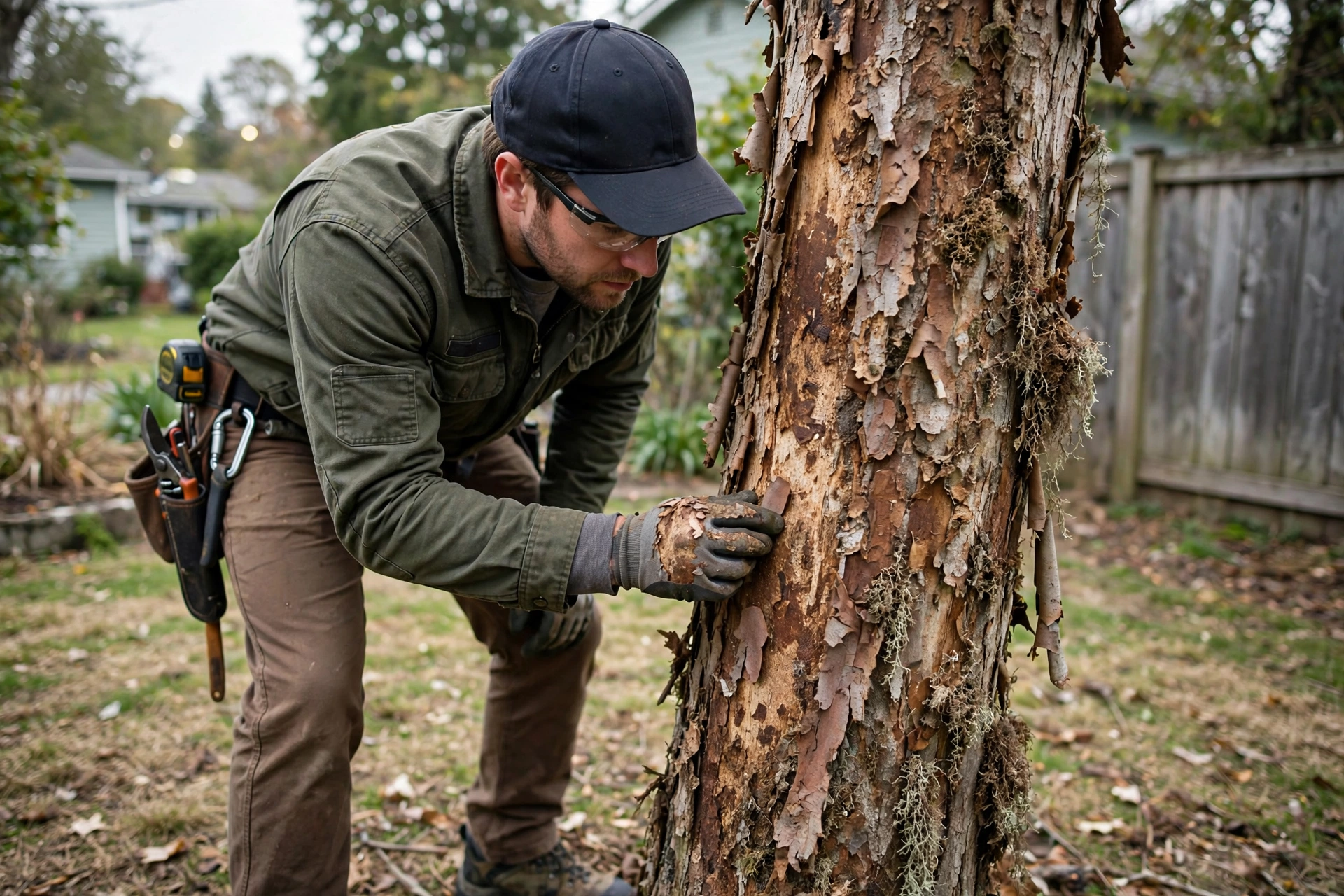
4. Peeling, cracked, or missing bark. Bark is the tree’s skin. Deep cracks, large patches falling off, or bark that comes away easily expose the wood underneath to disease and insects. A little shedding is normal for some species (like sycamore), but big changes aren’t.
5. A new or worsening lean. Trees lean a little as they grow toward light, and that’s fine. A lean that gets worse year after year — especially after storms — means the roots are failing. In the Illinois River valley, our wet clay soil makes root failure more common than people think.
6. Root or trunk damage. Construction, trenching, and even lawn mowers wounding the base over years all shorten a tree’s life. If the roots are cut on one side, the tree may stand for years — then fail suddenly in a storm.
7. Epicormic sprouts — weird little shoots everywhere. When a stressed tree throws out clusters of small shoots from the trunk and branches, it’s in survival mode. You’ll see this a lot on ash trees under attack, which brings us to our local nightmare.
How Can You Identify Emerald Ash Borer Damage on Ash Trees in Central Illinois?
Emerald ash borer (EAB) is confirmed in Peoria County, and it has killed millions of ash trees across the Midwest. If you have an ash tree in your yard, you need to know these signs — because once EAB damage is obvious, the tree is often past saving.
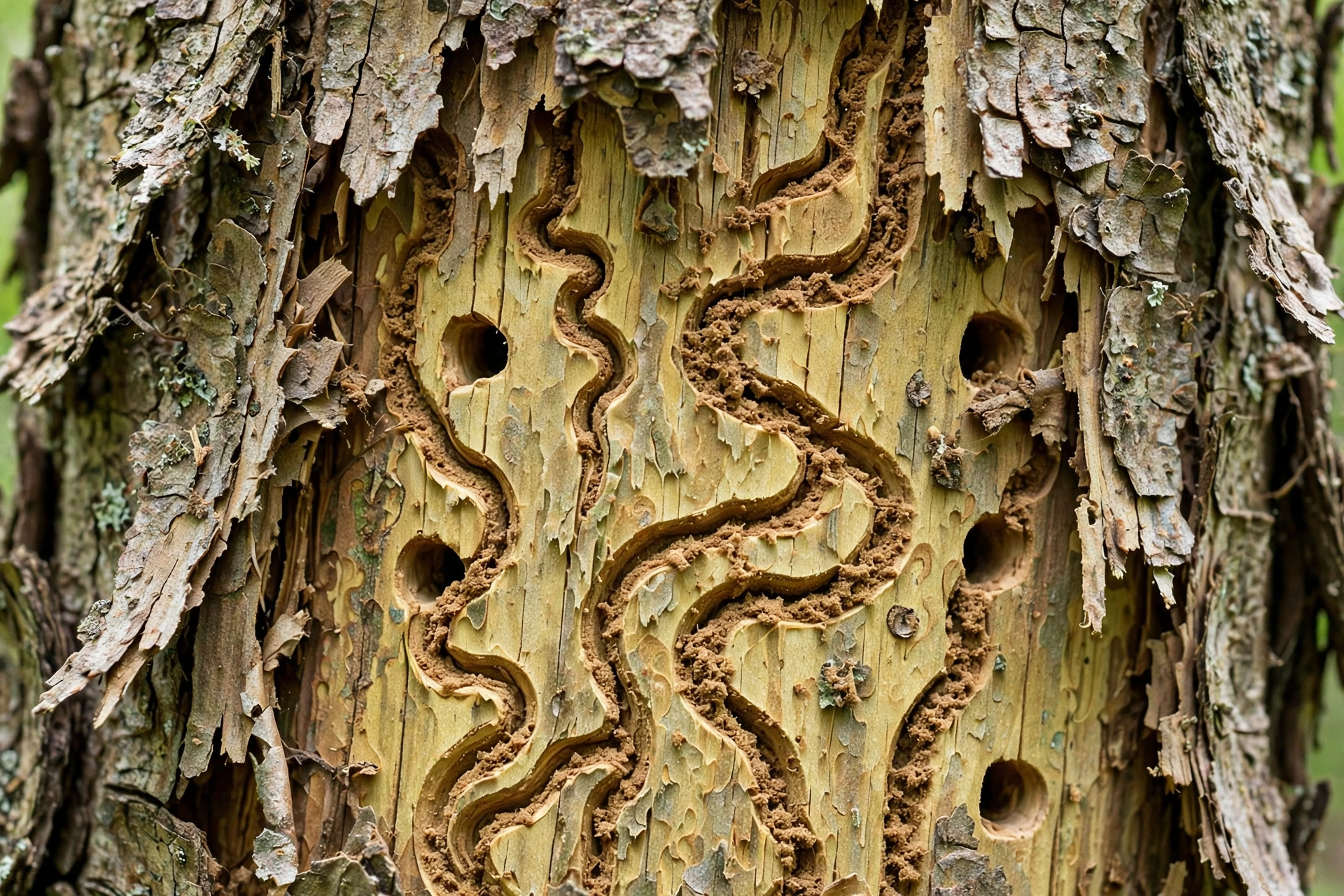
D-shaped exit holes. This is the smoking gun. Adult beetles chew their way out of the bark, leaving tiny D-shaped holes about the size of a grain of rice. No other common pest makes that exact shape.
Canopy dieback from the top down. EAB larvae cut off the tree’s water supply, so the crown dies starting at the very top. If the top third of your ash looks dead while the bottom still has leaves, suspect EAB.
Epicormic sprouts along the trunk. Those desperate little shoots we mentioned? Ash trees under EAB attack grow them in clusters all up the trunk.
Bark splitting and S-shaped larval galleries. Larvae tunnel in S-shaped patterns under the bark. As the bark splits and peels, you can sometimes see the winding galleries underneath.
Heavy woodpecker damage. Woodpeckers love EAB larvae. If your ash suddenly looks like a woodpecker playground, the birds are telling you something.
Treatment exists for ash trees caught early — but it has to be done by a professional, and it has to be repeated. A tree that’s lost more than half its canopy usually isn’t worth treating. We handle a lot of EAB removals in Chillicothe and across the river valley, where ash trees were planted everywhere along the streets.
Other Tree Diseases We See Around Peoria
EAB gets the headlines, but it’s not the only thing killing trees in Central Illinois. Oak wilt is the one we worry about most after EAB — it’s a fungal disease that moves fast, especially in red oaks, and it spreads both through root grafts and on beetles attracted to fresh pruning wounds. That’s exactly why we never prune oaks between April and July.
Dutch elm disease is still around too, spread by bark beetles — if your elm’s leaves yellow and wilt in midsummer starting at the top, that’s the classic pattern. And anthracnose hits sycamores and maples most springs: ugly brown blotches on the leaves that look alarming but are usually cosmetic. The tree leafs out again and moves on.
Bur oaks have their own local issue — bur oak blight — which causes leaf browning late in the season. It’s rarely fatal, but it weakens the tree over years, and it gets worse when the tree is already stressed by drought or construction damage.
The point: different diseases need different responses, and guessing wrong wastes money. An arborist’s diagnosis — which we provide free — tells you whether you’re dealing with something treatable, something to monitor, or something that needs to come down.
How We Diagnose Tree Problems
When we come out for a free assessment, here’s what actually happens. We walk the whole tree — roots, trunk, branches, canopy. We look at the soil and drainage around it. We check for the signs in this guide, plus a few you’d never notice: conks (shelf fungi) high on the trunk, included bark in branch unions, girdling roots at the base.
Then we give you a straight answer in plain language: what’s wrong, what your options are, and what each option costs. Sometimes the answer is “it’s fine, call us in two years.” We’d rather tell you that than sell you work you don’t need — that’s how you stay in business 17 years in one town.
What to Do If You Spot These Signs
First, don’t panic — and don’t grab a chainsaw. Some of these problems are treatable. A certified arborist can tell you whether your tree needs pruning, treatment, or removal, and that assessment is free when you call us.
Second, don’t wait. A dying tree gets more dangerous and more expensive to remove every month. Dead wood is brittle, which makes the removal harder and riskier — and a dead tree standing through an ice storm or a derecho is a gamble with your house.
For independent guidance on tree health, TreesAreGood.org and the Morton Arboretum both have excellent resources on diagnosing tree problems in the Midwest.
Save It or Remove It? An Honest Answer
Here’s what 17 years has taught us: about a third of the “dying tree” calls we get end with pruning or treatment, not removal. We’d rather save your tree and earn a customer for life than sell you a removal you don’t need.
But some trees are done. If the trunk is hollow, the roots are rotted, or more than half the canopy is gone, removal is the safe call — and delaying it only raises the price. Our full range of tree services covers everything from health assessments to safe removal, so whatever your tree needs, we can handle it.
Related Articles
- Is My Tree Dead or Dormant? How to Tell | Peoria IL
- Tree Disease Treatment in Peoria, IL: Can a Sick Tree Be Saved?
- When Should a Tree Be Removed in Peoria, IL? 7 Signs From a Local Arborist
Not Sure About Your Tree? Get a Free Assessment
If something looks off about your tree — thinning leaves, weird bark, mushrooms at the base — don’t guess. Call 309-250-8333. We’ll come out anywhere in our service areas, take a look, and give you an honest answer. Free estimate, no pressure.
Listen to This Article
Prefer listening? Hear the full article narrated:
Peoria Tree Removal Co.
(309) 250-8333
info@treeremovalpeoriail.com
https://treeremovalpeoriail.com/
114 W Forrest Hill Ave, Peoria, IL 61604, USA
Tree Service Company
9 Responses