
Tree care in Peoria runs on a calendar, not a crisis. Prune in winter, watch in spring, water in summer, feed the roots in fall — and your trees stay standing for decades.
Most Peoria homeowners think about their trees twice a year: when something falls, and when something has to come down. The trees themselves run on a different schedule. They need pruning while they are still dormant, a look-over as they leaf out, water through the dry weeks of summer, and food and moisture in the fall before the ground freezes. This calendar lays out what to do in each season in central Illinois, why the timing matters, and when a job belongs to a professional instead of a Saturday morning.
Quick Facts
- Peoria is zone 6a: first frost usually arrives between October 11 and 20, and the growing season runs roughly April through October.
- Winter is pruning season: most trees are best pruned while dormant, when structure is visible and pests are inactive.
- Never prune oaks in April, May, or June: fresh cuts in those months can attract the beetles that spread oak wilt.
- Bagworms hatch in June: check arborvitae and spruce in early summer, when treatment still works.
- Fall watering matters as much as summer watering: trees that go into winter dry come out damaged, especially evergreens.
- After a big storm, look up: cracked limbs and leaning trunks found early are cheaper than the damage they cause in the next storm.
How the Peoria Tree Year Actually Works
Central Illinois does not give trees an easy year. Spring arrives wet and changeable, summer brings heat and the occasional derecho — June 2024 is still the benchmark around here — fall cools fast, and winter brings ice storms and freeze-thaw cycles that split bark and heave roots. A tree that looks fine in July can be carrying a problem that started in February, and a tree that looks rough in March may just be waking up late. The calendar below is built around that rhythm: do the structural work when the tree is dormant, do the watching when it leafs out, do the watering when it is thirsty, and do the feeding when the roots are still active in fall.
Two rules run through every season. First, timing matters more than tools: pruning an oak in May instead of February invites oak wilt, which can kill a red oak in a single season, and daily sprinkling is not the same as a deep weekly soak. Second, a calendar is a guide, not a prescription — a young maple in Washington needs different attention than a sixty-year-old oak on Grandview Drive. Use the seasons below to know what to look for and when, and get a professional assessment when something does not look right.
Winter (December–February): Look, Prune, Plan
Winter is the best season to really see your trees. With the leaves off, deadwood, crossing branches, cankers, and structural problems are all visible from the ground. Walk the property on a mild day in January or February and look at each tree the way an inspector would: start at the trunk flare, where the trunk widens into the roots, and work upward. Bark peeling in sheets, deep cracks, mushrooms near the base, and branches that cross and rub are all worth noting. A full professional tree inspection does the same thing from the ground and the canopy, and winter is the easiest time to schedule one, because the crew can see everything.
Winter is also pruning season for most species. Dormant-season pruning has three advantages: the tree loses less sap, the cuts heal faster when growth resumes, and the insects and fungi that infect fresh cuts are inactive in the cold. This is the time for structural pruning on young trees, deadwood removal, and clearance work over roofs and driveways. It is also the safe window for oaks — prune them now, and never in April, May, or June, when sap-feeding beetles can carry oak wilt spores into fresh cuts. The International Society of Arboriculture recommends the same discipline: prune at the right time for the species, and never top a tree to make it smaller.
Two things not to do in winter: do not fertilize — it sits unused until spring — and do not prune a stressed tree heavily; it needs its energy for recovery, not for pushing new growth into a freeze. If a tree leaned further after the last ice storm, or a large limb hangs by a strip of bark, that is not a pruning job — it is a hazard, and it should be dealt with promptly. Our guide to winter tree care covers the coldest months in more detail.
Spring (March–May): Wake-Up Checks and New Growth
Spring is the season of diagnosis. As each tree leafs out, compare it with its neighbors and with itself last year. A tree that leafs out late, leafs out on one side only, or produces leaves that are small and pale is telling you something about its roots or its health. The causes vary — compacted soil from a winter of foot traffic, a grade change from landscaping, root damage from a new driveway — but the signal is the same: the tree is stressed, and the cause is worth finding while there is still a growing season to fix it.
This is also the season to check for the pests that define central Illinois tree care. Emerald ash borer leaves D-shaped exit holes and thins the crown from the top down; if you have ash trees, look for them now, and read our guide to emerald ash borer signs before deciding anything. Bagworms hatch in June, so late spring is the time to inspect arborvitae, spruce, and other evergreens for last year’s bags — handpicking them now removes the eggs before they hatch. A soil test in spring tells you whether feeding will actually help; fertilizer without a test is a guess, and a tree that is struggling because its roots are compacted will not be fixed by feeding the canopy.
Spring is the best time to plant, too. A tree planted in spring has the whole growing season to establish roots before winter, and our guide to the best time to plant a tree in Illinois covers species and timing. If you are planting, remember the spacing question that causes most future removals: a tree planted ten feet from the house will be a problem tree in twenty years, no matter how small it looks in the pot. Give it room for its mature size, keep mulch two to four inches deep and pulled back from the trunk, and water it deeply through its first two summers.
Summer (June–August): Water, Watch, and Storm Season
Summer in Peoria is when trees get thirsty and storms get serious. The watering rule is simple and often done wrong: deep and slow beats shallow and often. A sprinkler that wets the top inch of soil every day teaches roots to stay at the surface, where they dry out fastest. A soaker hose or slow trickle at the dripline — the circle under the outer edge of the branches — that soaks eight to twelve inches down, once a week in a dry spell, builds roots that can find water on their own. Young trees need this most; their root systems are still small, and a dry July can set a newly planted tree back a full year.
Summer is also when you watch for the problems that arrive with the heat. Wilting and early leaf drop usually mean thirst, not disease — water first, and see if the tree recovers before assuming the worst. Leaf scorch, the browning of leaf edges that creeps toward the veins, is heat and drought stress. Bagworms are small and treatable in June and nearly impossible to control by August, when the bags are large and the caterpillars are protected inside them. And after every big storm — the June 2024 derecho is the local reminder of what a single afternoon can do — walk the property and look up. Cracked limbs, hanging branches, and trunks that lean a little further than they did yesterday are the damage the next storm will finish. Our storm-season preparation checklist is the pre-storm version of this same walk.
One summer rule that saves more trees than any product: do not prune heavily in the heat. A tree in drought is already spending its energy on survival; removing a large part of its canopy at the same time is a second stress on top of the first. Light deadwood removal is fine. A major reduction in July is not. And do not fertilize a heat-stressed tree — high-nitrogen fertilizer pushes tender new growth that the tree cannot support while it is short of water.
Fall (September–November): Feed the Roots and Get Ready
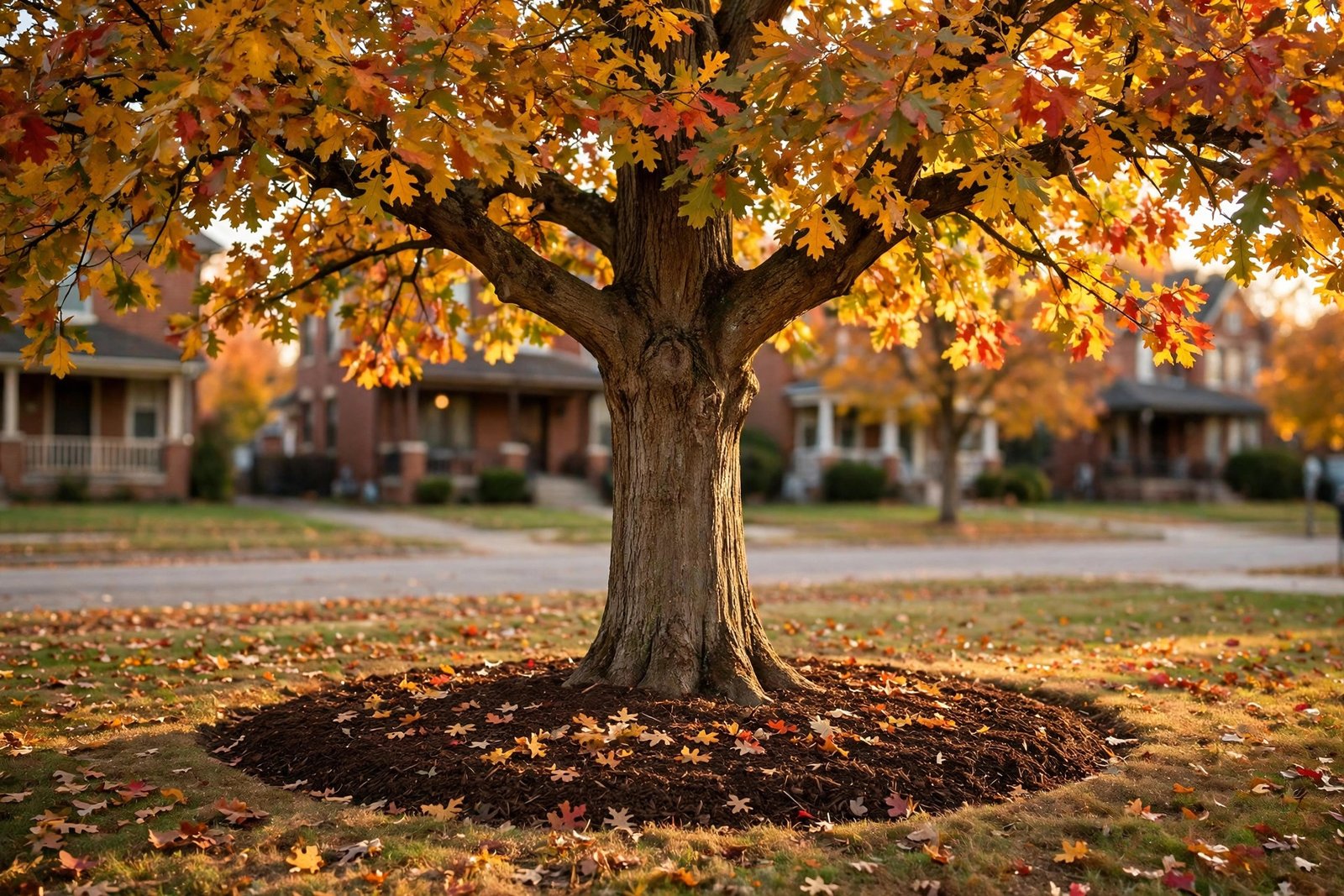
Fall is the most underrated season in tree care, because the work you do now pays off in spring. Roots keep growing after the leaves fall, as long as the soil is still warm, which makes fall the right time for deep-root fertilization — but only where a soil test shows a real deficiency. Feeding every tree every fall, without ever testing, is selling fertilizer, not caring for trees. The trees that benefit most are the ones in compacted or poor soil: street trees, trees in new subdivisions, and trees that have been struggling all summer.
Fall watering matters just as much. Trees go into winter needing moisture in the root zone, and a dry fall is how evergreens come out of winter brown and scorched. Keep watering — deeply, at the dripline — during dry spells until the ground freezes. Top up mulch to two to four inches, pulled back from the trunk, to hold that moisture and insulate the roots. Our first-frost task list walks through the full pre-winter routine, from watering to wrapping young trunks.
Fall is also the season to deal with the trees you have been watching all year. A tree that never leafed out properly, a maple with a worsening lean, an ash that has lost another third of its crown — these are decisions to make now, while the ground is still workable and before ice and snow make the job harder and more expensive. Winter tree removal is possible on frozen ground, but the best time to remove a tree you already know is coming down is before winter arrives. If the tree is over the house, the driveway, or the power line, get the decision made and the work scheduled while the weather still cooperates.
The Whole Year at a Glance
| Season | Do this | Watch for | Avoid |
|---|---|---|---|
| Winter (Dec–Feb) | Dormant pruning, structural work, professional inspection | Deadwood, cankers, crossing branches, new leans after ice | Pruning stressed trees heavily; fertilizing |
| Spring (Mar–May) | Leaf-out checks, soil testing, planting, bagworm-bag removal | Late or one-sided leaf-out, EAB signs on ash, small pale leaves | Pruning oaks in April–June; fertilizing without a soil test |
| Summer (Jun–Aug) | Deep slow watering at the dripline; post-storm checks | Wilting, leaf scorch, bagworms on evergreens, cracked limbs | Heavy pruning in heat; fertilizing drought-stressed trees |
| Fall (Sep–Nov) | Deep-root feeding where soil tests support it; watering until freeze; mulch top-up | Trees that never recovered, worsening leans, thinning ash crowns | Letting trees go into winter dry; piling mulch against trunks |
Print that table, or save it on your phone. It is the whole calendar in one place, and it is the fastest way to answer the question every homeowner asks in April: “Is it too late to do something about this tree?” Usually it is not too late. It is just a different job than it would have been in February.
When the Calendar Says “Call Someone”
A calendar tells you what to do. It does not tell you whether a specific tree is safe. Call a professional when you see any of these: a tree leaning further after a storm, with soil heaving on one side; a large dead limb hanging over the house, the driveway, or a sidewalk; mushrooms growing at the base or on major roots; bark peeling off in sheets, or a crack that runs deep into the trunk; a crown that has thinned by a third or more. These are the signs of a tree in decline or a tree that has become a hazard, and they are the signs that a free estimate is worth more than another season of waiting. A plant health care plan is the scheduled version of this calendar — the same inspections and treatments, done by someone who knows your trees’ history — and it is worth considering if you have several mature trees you want to keep for decades.
When the tree needs to come down rather than be cared for, that is a different job with different equipment and different risks. Our tree removal service handles removals, including trees in tight yards and trees near houses and power lines. And if the job involves branches near a service drop, remember that only Ameren disconnects those lines, by scheduled appointment — a tree crew should never cut near a live line on its own.
Frequently Asked Questions
What month is best for tree pruning in Peoria?
Late winter — February into early March, while trees are still dormant — is the best window for most species. You can see the structure, pests are inactive, and cuts heal fast when growth resumes. The one firm exception is oaks: never prune them in April, May, or June, when oak wilt beetles are active.
How often should my trees be professionally inspected?
At least once a year for most properties, with an extra look after major storms. Mature trees, trees near the house, and trees with a known problem benefit from two visits a year — one in late winter, one in summer.
Should I water my trees in the fall?
Yes, if the fall is dry. Water deeply at the dripline until the ground freezes. Trees that go into winter dry, especially evergreens, come out of winter damaged. A soaker hose once a week in a dry spell is enough.
Can I do all of this myself?
Much of it, yes. Watering, mulching, watching for the warning signs in this calendar, and handpicking bagworm bags are all homeowner jobs. Diagnosis, structural pruning, work near power lines, and anything involving a chainsaw above shoulder height are professional jobs.
What if I just moved in and have no idea what trees I have?
Start with a late-winter inspection, when the structure is visible and an arborist can identify species, spot problems, and tell you what each tree needs in the coming year. It is the cheapest way to inherit someone else’s yard with confidence.
Start With the Season You Are In
You do not need to do the whole calendar at once. You need to do the part that belongs to the season you are in, and then do the next part when its season arrives. Walk your yard this week — in November, that means watering if it has been dry, topping up mulch, and deciding about any tree you have been watching all year. Then put the calendar somewhere you will see it in February, when pruning season opens and the trees are bare enough to read. The trees will do the rest, one season at a time, if you give them the right work at the right time.
Call Peoria Tree Removal Co. at (309) 250-8333 for a free estimate, and ask for a tree health assessment — what is healthy, what needs work, and what can wait until its season comes around.
Peoria Tree Removal Co. — 114 W Forrest Hill Ave, Peoria, IL 61604 — (309) 250-8333 — https://treeremovalpeoriail.com/
Peoria Tree Removal Co.
114 W Forrest Hill Ave, Peoria, IL 61604
Mon–Sat 8am–6pm · 24/7 emergency tree service