
Rhizosphaera needle cast is a slow fungus that browns and drops a blue spruce’s older needles from the bottom up, and November is when the damage is easiest to see.
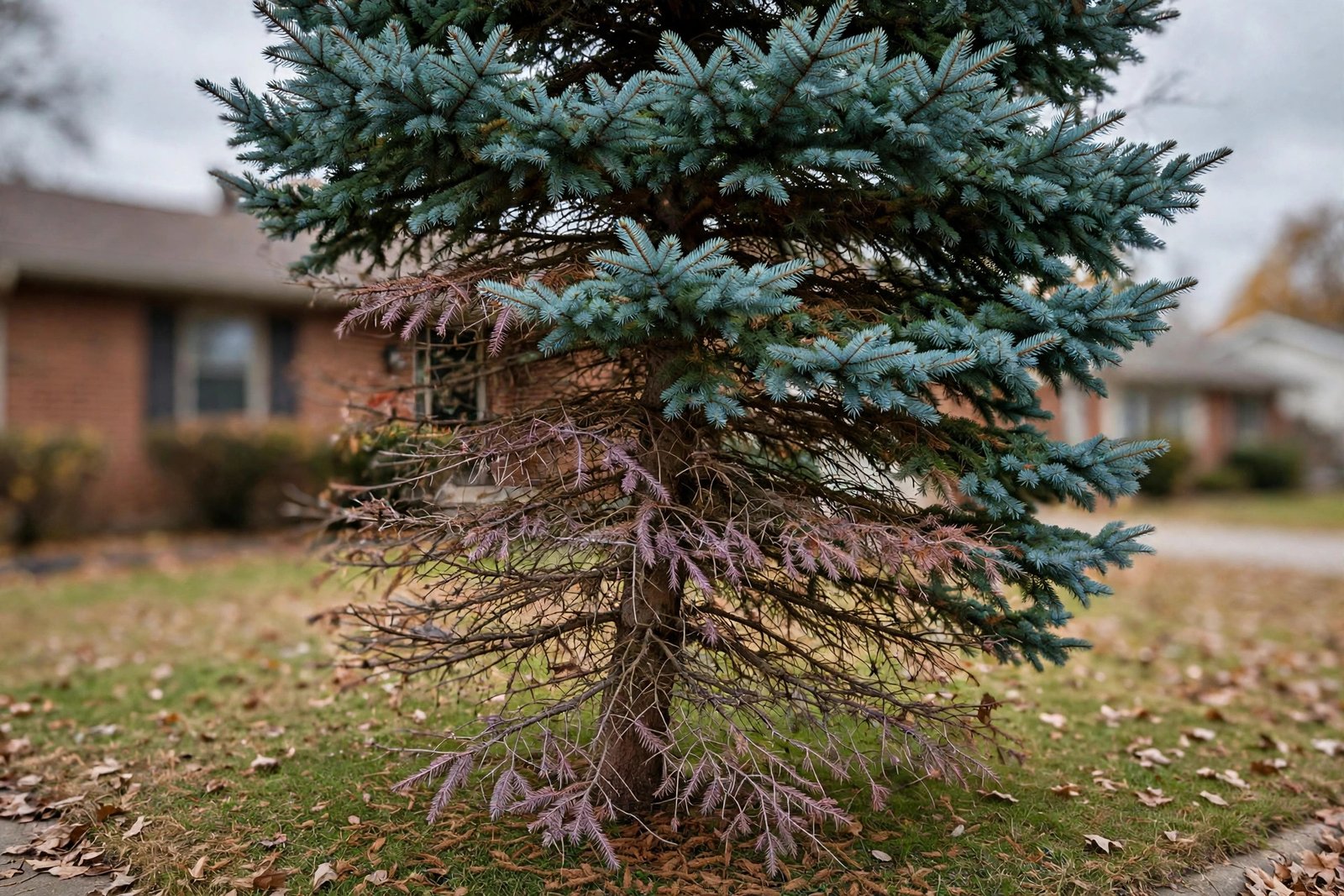
Your blue spruce looks thinner every year, but the top still looks fine. That pattern — green on top, bare and brown below — is the calling card of Rhizosphaera needle cast, the most common disease of Colorado blue spruce in Illinois. It will not kill the tree in one season, but left alone it can strip a spruce bare over several years, and a spruce does not grow its needles back.
Quick Facts
- The disease: Rhizosphaera needle cast, caused by the fungus Rhizosphaera kalkhoffii.
- Main host: Colorado blue spruce — the most susceptible spruce in Illinois; white spruce is moderately resistant, Norway spruce mostly resistant.
- The pattern: infection starts on lower branches in spring, works upward, and shows up 12 to 18 months later as purplish-brown needles that drop.
- The test: tiny black fruiting bodies in rows on dead needles, or a University of Illinois Plant Clinic sample for a certain answer.
- The fix: preventive fungicide in spring, two sprays a year for at least two years, plus airflow and dry foliage — no cure for needles already brown.
- The decision: a spruce that has lost more than half its canopy rarely becomes attractive again, because spruces do not refoliate bare branches.
What Rhizosphaera Needle Cast Actually Is
Rhizosphaera needle cast is a fungal disease caused by Rhizosphaera kalkhoffii. It infects spruce needles in the spring, usually in the roughly two-month window after bud-break, when wet weather lets spores spread from infected needles to new ones. The part that trips homeowners up is the delay: nothing looks wrong for a year or more. Needles infected this spring can look perfectly healthy through the summer. They usually turn a mottled yellow by late summer, then brown — purplish brown on a Colorado blue spruce — during late winter and early spring, and they fall off during the following summer and fall.
That 12-to-18-month delay is the whole story of this disease. By the time you notice brown needles, the infection that caused them happened last spring or the spring before. The University of Illinois Extension calls it a disease seen frequently in Illinois, and it is the reason so many older blue spruces around Peoria look like green-topped skeletons — full at the crown, bare and twiggy below.
The damage is not just cosmetic. A spruce keeps its needles for several years, and each year’s needles do the tree’s photosynthesis. When the disease strips the one- and two-year-old needles off the lower branches year after year, the tree loses its food-making capacity from the bottom up, leaving a weakened tree with thin branches carrying only tufts of new needles at the tips. Unlike a maple or an oak, a spruce does not sprout new growth on bare old wood — once a branch is bare, it stays bare.
Which Peoria Spruces Are at Risk
Colorado blue spruce is the one to watch. It is the most susceptible spruce to Rhizosphaera, and it is also the spruce Peoria homeowners planted most often for decades — the classic blue Christmas-tree shape in front yards from the North Valley to Dunlap, along Grandview Drive, and in the older subdivisions off War Memorial Drive and Knoxville Avenue. That combination — a much-loved tree that happens to be the most vulnerable — is why this disease shows up so often here.
White spruce is moderately resistant, and Norway spruce is mostly resistant. Age matters too: Extension notes that any size tree can be attacked, but trees over 20 years old are more likely to be infected. The big blue spruce that has anchored a Peoria Heights front yard since the 1990s is squarely in the risk window.
Site stress makes it worse. A spruce planted too close to a house, crowded by other plantings, sitting in wet soil, or hit by a sprinkler every night is a better target than one with open air around it. Central Illinois summers are humid, and a spruce growing outside its native mountain habitat — which is most of them here — is already living at the edge of what it likes.
The Signs: Read Your Spruce This November
November is the best month to read this disease, because the needles that turned brown over late summer and fall are dropping now, and the bare-branch pattern is out in the open. Walk around the tree and look at it from all four sides.
Bottom-up thinning. The disease starts on the lower branches and works upward — the lowest branches lose their needles first, then the next tier, while the top stays full and green. If your spruce looks like a lollipop, dense on top and bare below, that is the classic picture. A healthy spruce sheds its oldest interior needles evenly, not whole lower branches.
Purplish-brown needles, not straw-colored ones. Infected needles turn a mottled yellow in late summer, then a distinct purplish brown by late winter and early spring. That purple-brown color is a real clue. Extension is explicit about what Rhizosphaera is not: light brown, straw-colored, or yellowing needles point elsewhere — usually winter burn or drought — as do banding, spotting, or stippling. If the dead needles are straw-colored, look at winter burn first.
Needles that drop, leaving bare twigs with green tips. The dead needles fall off during summer and fall, leaving branches bare except for a tuft of current-year needles at the end. That tufted look — bare stem, green tip — is the signature of a needle cast. The newest growth stays green even on a badly infected tree, which is why the tree can look fine from the street and terrible up close.
Tiny black dots in rows. Look closely at a dead needle with a hand lens. The fungus produces tiny black fruiting bodies that emerge from the needle’s stomata, so they sit in neat rows along the needle — the field test an arborist uses. There is a lookalike: Stigmina needle cast makes very similar fruiting bodies, and Extension warns to look closely at their shapes, because a quick glance can confuse them. If you cannot tell them apart, that is what the Plant Clinic is for.
Rhizosphaera vs. Winter Burn vs. Drought vs. Pine Wilt
Brown evergreens in Illinois have several causes, and treating the wrong one wastes money and a season. This table sorts the four you are most likely to meet in a Peoria yard.
| Pattern | Likely cause | Key difference | Can it recover? |
|---|---|---|---|
| Bottom-up thinning, purplish-brown needles, black dots in rows | Rhizosphaera needle cast (spruce) | Only spruces; 12–18 month delay; newest growth stays green | Partly — fungicide protects new needles, bare branches stay bare |
| South and west sides bronze after winter | Winter burn | One-sided, after a cold windy winter; straw-colored needles | Usually, if buds are alive |
| Top-down browning, dry brittle lower branches after drought | Drought stress | Whole tree, worst at the top; no fruiting bodies | Yes, with deep watering |
| Top-down browning, needles stay attached, whole pine browns in weeks | Pine wilt nematode (pine, not spruce) | Pines only; very fast; needles stay on | Almost never — remove promptly |
Two points deserve emphasis. First, pine wilt is a pine problem, not a spruce problem — if your browning tree is a spruce, pine wilt is not on the list, and if it is a pine, Rhizosphaera is not. The guide to pine trees turning brown in Illinois walks through the pine side, including pine wilt and the pine needle-cast fungi. Second, winter burn and drought both improve with time and water. Rhizosphaera does not — if the same branches keep browning a little higher each year, stop waiting it out and get a diagnosis.
How to Confirm the Diagnosis
You can get close on your own with a hand lens and the fruiting-body rows, but Extension’s advice is to get a positive identification before you spend money on treatment, because other problems mimic these symptoms. The reliable route is a sample to the University of Illinois Plant Clinic, which identifies the pathogen for you. Cut a few affected branches — branches showing the purplish-brown needles, not just dead bare ones — bag them, and follow the Plant Clinic’s submission instructions. A sample taken in fall, when symptoms are showing, is far more useful than one taken in spring, when infected needles still look green.
A professional inspection is the other route, and it answers the question a lab sample cannot: how much of the tree is gone, and is it still worth treating? A professional tree inspection in Peoria looks at the whole tree — canopy loss, structural soundness, site conditions — not just the needles. The guide to bagworms on evergreens in central Illinois makes the same point for a different pest: browning evergreens have several causes, and treating the wrong problem is the most expensive kind of treatment there is. If you are unsure, see the University of Illinois Extension’s plain-language guide to what Rhizosphaera is — and is not before you buy anything.
What You Can Do: The Two-Year Plan
There is no spray that cures needles already brown. Every fungicide for Rhizosphaera is preventive — it protects the new needles coming out, and it does nothing for the ones already infected. That single fact shapes the whole plan, and it is why the plan runs two years, not one.
Spray in spring, twice, for two years. Extension’s timing is specific: the first application goes on when the new needles are about half elongated — roughly when the bud caps have fallen off — and the second when the needles reach full length, about two to three weeks later. Active ingredients labeled for Rhizosphaera include chlorothalonil, chlorothalonil plus thiophanate-methyl, copper, and copper hydroxide. Because the fungus needs 12 to 18 months to show symptoms, at least two years of sprays are usually required before you can judge whether the program is working. Read the label for the product you use and follow it exactly.
Dry the foliage out. The fungus spreads in wet weather, so anything that keeps needles wet helps it. Water the soil, not the branches. Move sprinklers so they do not hit the spruce, and never water at night — wet needles overnight are an open invitation. Thin crowded plantings around the tree so air moves through the canopy.
Clean up the fallen needles. Infected needles on the ground are the source of next spring’s spores. Rake them up and destroy them — bag them and throw them away, or burn them where that is allowed. Do not compost them back under the tree, and do not chip them into mulch for the same bed. Remove dead or severely affected branches in dry weather, which improves air circulation and takes infected material out of the canopy, and dispose of the cuttings rather than leaving them under the tree. The fall deep-root fertilization guide on this site covers the wider autumn care routine that keeps a spruce drying out between wettings.
Feed the tree, not the fungus. A stressed spruce is a susceptible spruce, so the basics matter: deep, slow watering at the dripline during dry spells, a proper mulch ring kept off the trunk, and no wounding from mowers or string trimmers. Do not fertilize a struggling spruce in the hope of forcing growth — pushing soft new growth in a wet spring just gives the fungus more tender needles to infect.
When Removal Is the Right Call
Honesty matters here, because the wrong call wastes two years of spraying on a tree that will never look right again. A spruce that has lost more than half its canopy rarely becomes attractive again — the bare interior branches will not refill. If the lower two-thirds is bare and the decline is still climbing, the tree is a candidate for removal, not another season of treatment.
Safety tips the decision. A large spruce leaning toward a house, a driveway, or a walkway in a tight Peoria Heights lot is a different question from a spruce standing alone in a big back yard. Dead lower branches get brittle and drop in wind, and a weakened spruce is more vulnerable in the next ice storm — Peoria’s zone 6a winters and the June 2024 derecho are reminders that weak trees fail first. If the tree is a hazard, or if it is already more bare branch than tree, the sensible move is removal and replacement. The guide to when a tree should be removed walks through that decision in full, and the tree removal cost guide explains what drives the price — no figure in this post is a quote for your tree.
What to Plant Instead
If the spruce comes out, do not plant another Colorado blue spruce in the same spot and expect a different result. Norway spruce is mostly resistant to Rhizosphaera, and white spruce is moderately resistant — both give you the evergreen shape without the same vulnerability. A Norway spruce will grow larger and faster than a blue spruce, so give it room: the guide to how far to plant trees from the house covers spacing by mature size.
A non-spruce evergreen is the other honest option. Eastern redcedar, arborvitae, and some pines all sidestep this fungus entirely, though each brings its own pest list — the tree pest and disease decision guide walks through the treat-or-remove question for the common ones. Whatever you plant, the rules do not change: open air around the tree, water at the soil, mulch kept off the trunk, and no sprinkler hitting the foliage every night. The best replacement trees for Peoria guide covers the species that do well here, and the tree disease treatment page explains what treatment can and cannot do.
Frequently Asked Questions
Will Rhizosphaera needle cast kill my blue spruce?
It can, over several years. A few years of heavy infection cause severe defoliation, and a spruce that keeps losing its older needles gets weaker each season. A lightly infected tree with good air circulation and a two-year spray program can hold on for years. A heavily thinned tree with more than half its canopy gone rarely recovers its looks, even if the fungus is controlled.
Can I just prune the brown branches off and skip the fungicide?
Pruning helps — it improves air circulation and removes infected material — but it does not stop the fungus, because the infection is already in needles that still look green. Pruning without the spring sprays leaves next year’s needles unprotected. The program works as a pair: prune in dry weather, spray in spring, and clean up the fallen needles.
When exactly do I spray in the spring?
The first spray goes on when the new needles are about half elongated, roughly when the bud caps have fallen off, and the second when the needles reach full length, about two to three weeks later — usually in May in central Illinois, but it moves with the spring, so watch the tree, not the calendar. A fall spray does nothing, because infection happens in spring.
Is Rhizosphaera the same as the needle cast on my pine?
No. Rhizosphaera needle cast is a spruce disease, caused by Rhizosphaera kalkhoffii. Pine needle cast is caused by different fungi — Dothistroma and Lophodermium among them — on a different host. The pattern looks similar from a distance, but the host tells you which one it is.
My spruce is thinning but the needles are straw-colored, not purplish-brown. Is it Rhizosphaera?
Probably not. Extension is clear that Rhizosphaera is not light brown, straw-colored, or yellowing needles — those point to winter burn or drought instead. Check which side browned and whether the tree went through a dry summer. If you are unsure, a Plant Clinic sample settles it before you spend money on the wrong fix.
Walk Your Spruce Before Winter Sets In
Rhizosphaera is the slowest problem a blue spruce can have, and the easiest to ignore for a year too long. It does not kill in a season like pine wilt can, and it does not arrive on beetles like Dutch elm disease. It takes a few needles, waits a year, and takes a few more.
Walk your spruce this week. Look at it from the bottom up, check the color of the dead needles, and look for the black dots in rows with a hand lens. If the lower branches are bare and the pattern is climbing, photograph what you see, rake up the fallen needles, and plan the spring around what the tree is telling you. If the tree is already more bare branch than spruce, get an honest assessment before you spend two more seasons spraying it — sometimes the right move is a resistant replacement and a fresh start.
Peoria Tree Removal Co. — 114 W Forrest Hill Ave, Peoria, IL 61604 — (309) 250-8333 — https://treeremovalpeoriail.com/
Peoria Tree Removal Co.
114 W Forrest Hill Ave, Peoria, IL 61604
Mon–Sat 8am–6pm · 24/7 emergency tree service