
A hot, dry Peoria summer can push a healthy tree into stress in weeks. Learn the signs, water deeply and slowly, and most trees bounce back.
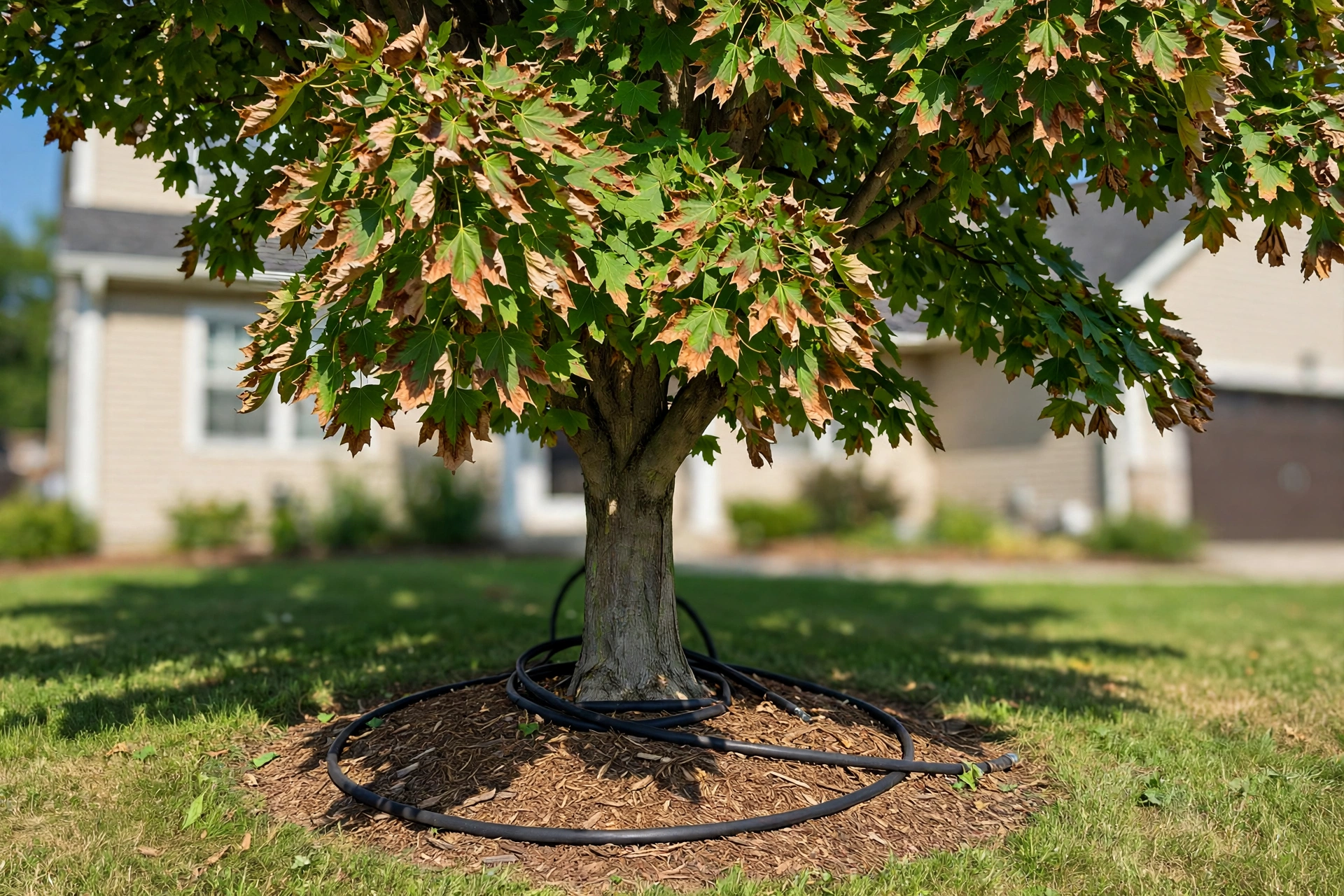
A heat-stressed tree in Peoria shows wilting leaves, brown scorched edges, early leaf drop, and thinning growth. The fix is slow, deep watering at the dripline — a soaker hose once a week in a dry spell, soaking 8–12 inches down — plus 2–4 inches of mulch kept off the trunk. Do not fertilize or heavily prune a stressed tree.
Quick Facts
- First sign: wilting still there in the morning, not just in the afternoon.
- Leaf scorch: brown, dry edges creeping inward — a water problem, not disease.
- Deep watering: soak 8–12 inches down at the dripline, about once a week.
- Mulch: 2–4 inches deep, kept off the trunk flare, never piled against bark.
- Do not fertilize or heavily prune a stressed tree.
- Most vulnerable: silver maple, birch, dogwood, Japanese maple. Mature oaks hold up better.
What Heat Stress Does to a Tree
A tree in July loses water through its leaves faster than its roots can replace it on a hot, dry, windy stretch — that gap is heat stress, and it shows up in the leaves first. Peoria’s zone 6a summers are uneven, its clay soil dries hard and cracks, and pavement gives back heat at night, so a street tree on Sheridan Road runs hotter than the same species in Bradley Park. The June 2024 derecho is still the local reminder of what one storm can do. Caught early, it is one of the most fixable tree problems there is: a wilting tree in August is usually thirsty, not dying.
How to Tell If Your Tree Is Heat Stressed
The signs build slowly. A healthy tree wilts in the afternoon and perks back up by morning; a stressed tree does not, because the soil is dry all the way down.
- Wilting that lasts into the morning. Leaves droop, look dull, and feel limp. Still wilted at sunrise? Water now.
- Leaf curling and cupping. Leaves fold inward, cutting down the surface that loses water.
- Leaf scorch. Leaf edges turn brown, dry, and papery, creeping inward toward the veins.
- Early leaf drop. The tree sheds leaves in July or August.
- Thinning canopy. You can see more sky through the crown than last year, and the leaves look smaller.
- Twig dieback. The smallest twigs at the branch tips dry out and snap off easily; dieback spreading inward from many tips is a warning.
Before you water, do the screwdriver test: push a long screwdriver into the ground at the dripline — the circle under the outer edge of the branches. In moist soil it slides in 6–8 inches easily. If it stops at two inches and the soil is dry and crumbly, water; if it slides in and the soil is damp, something else is wrong.
Heat Stress or Something Else?
Wilting and brown leaves can come from several causes, and watering the wrong one can make it worse. The soil test above is the fastest way to sort them out.
Heat and drought stress usually hits the whole canopy at once after a dry spell, and the tree perks up within a few days of a deep watering.
Disease tends to be patchier. Bacterial leaf scorch returns on the same branches year after year and spreads slowly. Fungal spots have a pattern — rings, dots, or blotches — while heat scorch is a plain dry brown edge with no pattern.
Overwatering looks like underwatering: wilting, yellowing, and leaf drop. The difference is in the soil — soggy, sour-smelling, or muddy soil means the roots are starving for air, and more water will only make it worse.
Pests leave their own evidence: chewed leaves, sawdust-like frass, small holes in the trunk, or insects under the leaves. A tree wilting on one side only often has a root-zone problem — a severed root, a girdling root, or compacted soil — rather than a canopy disease.
If the checklist still leaves you unsure, a professional assessment earns its keep. Our guide to tree pest and disease treatment walks through the treat-or-remove decision, and our plant health care page covers the care program that keeps small problems from becoming big ones.
Deep Watering a Heat-Stressed Tree the Right Way
Deep watering is not the same as watering the lawn: a lawn wants a light watering often, while a tree wants a slow, deep soaking rarely, so the water sinks down to where the roots actually live.
Where to water. Water at the dripline, not at the trunk — the fine feeder roots grow out under the outer edge of the branches. For a young tree, water in a ring a foot or two out from the trunk and widen it as the tree grows. Watering at the base mostly wets bark, and wet bark invites rot.
How to water. A soaker hose is the best tool for most Peoria yards: lay it in a ring around the dripline, turn it on low, and let it run until the soil is wet 8–12 inches down. A slow trickle from a garden hose, moved around the dripline every 20–30 minutes, works too.
When to water. Water in the morning, so the tree can take it up during the day and the leaves dry before night. In a dry spell, about once a week is right for most established trees; young trees in their first two summers may need it twice a week. After a real soaking rain — not a ten-minute shower — skip that week and check the soil first.
Why shallow watering hurts. A daily sprinkle that wets the top inch of soil teaches roots to stay at the surface, where they dry out fastest. Deep, infrequent watering pulls the roots downward, into cooler soil that holds moisture longer. The University of Illinois Extension publishes tree care guidance for Illinois homeowners that lines up with this method: slow, deep, and at the dripline.
Which Peoria Trees Suffer Most — and Which Hold Up
| Tree | Heat and drought tolerance | What to watch for |
|---|---|---|
| Silver maple | Low — one of the thirstiest yard trees | Wilts early, scorches fast, drops leaves by August |
| Birch | Low — shallow roots dry out quickly | Leaves yellow and drop from the top down |
| Dogwood | Low — prefers cool, moist roots | Leaf edges brown and curl |
| Japanese maple | Low — scorches in hot sun and wind | Leaf edges crisp and brown, sunny side first |
| White oak | Good — most drought-tough Peoria tree | Slow to show stress, so check the soil |
Young trees are more vulnerable than mature ones, because their roots have not yet grown out to the dripline — a newly planted tree in its first two summers is the first tree to water in a dry spell, every time. Location matters too: a tree in a narrow parkway strip has less soil to draw from than a tree in a deep, mulched bed near Forest Park Nature Center or the Illinois River bluffs. Red oak and honey locust cope better, and a mature white oak on Grandview Drive may need no extra watering at all in a normal summer.
What NOT to Do to a Stressed Tree
A stressed tree is running on empty, so the big, fast moves are usually the wrong ones.
- Do not fertilize it. Fertilizer pushes new growth the roots cannot supply with water. High-nitrogen fertilizer is the worst choice in midsummer.
- Do not prune it heavily. A stressed tree needs every leaf it has. Remove only dead, broken, or hazardous branches.
- Do not pile mulch against the trunk. Mulch helps only spread 2–4 inches deep in a wide ring and kept off the trunk flare. Piled against the bark, it invites rot.
- Do not water every day. Daily sprinkling keeps the surface wet and the deep roots dry.
Recovery, and When Watering Is Not Enough
Recovery is slow, and that is normal: wilting eases within a few days of deep watering, new growth appears within two to three weeks, and the canopy fills out by season’s end. Next spring is the real test — a tree that leafs out fully, on time, and evenly has recovered. Keep watering through the fall, because a tree that goes into winter dry comes out damaged; our fall and winter watering guide covers the cold-season side, and the first frost usually arrives between October 11 and 20 in Peoria. Most heat-stressed trees recover with water, mulch, and patience. A few are past that point — and a dying tree can become a hazard. Call for a professional assessment if you see any of these:
- Dieback is spreading — dead twigs moving inward from the branch tips instead of recovering.
- Mushrooms or fungi are growing at the base. Shelf fungi around the trunk flare usually mean decay inside the trunk or roots.
- The tree has developed a new lean, or the soil around the base is cracked and lifting on one side. That points to root failure.
- No recovery after a month of proper watering. If the soil is damp 8–12 inches down and the tree still looks worse every week, the cause is probably not drought.
- You are not sure whether the tree is dead or dormant. Our guide on whether a tree is dead or dormant walks through the scratch test and the checks you can do from the ground.
Frequently Asked Questions
How do I know if my tree is heat stressed or dying?
Check the soil with a screwdriver at the dripline. If it is dry 6–8 inches down and the tree perks up within a few days of deep watering, it was heat stressed. If the soil is damp, dieback keeps spreading, or mushrooms grow at the base, get an assessment.
How often should I water a tree in a Peoria summer?
About once a week in a dry spell, soaking 8–12 inches down at the dripline. Young trees in their first two summers may need it twice a week.
Should I fertilize a heat-stressed tree?
No. Fertilizer pushes new growth the roots cannot support with water, and high-nitrogen fertilizer in midsummer makes the stress worse. Wait until the tree has recovered, and only fertilize after a soil test.
Can a tree recover from leaf scorch?
Yes, usually. Scorched leaves stay brown until they fall naturally, but the tree recovers if the buds and branches are still alive. Deep watering and proper mulch bring most scorched trees back.
When should I call an arborist instead of watering?
Call when dieback spreads after weeks of watering, when mushrooms or fungi appear at the base, when the tree develops a new lean, or when you cannot tell whether the tree is stressed or dead.
The Bottom Line
A Peoria summer will test every tree in the yard, and the ones that come through best got water where it counts: slow, deep, at the dripline, once a week in a dry spell, with mulch holding moisture in the soil. Check the soil before you water, and skip the fertilizer and heavy pruning while the tree is stressed.
If you are not sure whether your tree is stressed, dying, or just having a rough August, call Peoria Tree Removal Co. at (309) 250-8333 for a free estimate and an honest assessment.
Peoria Tree Removal Co.
114 W Forrest Hill Ave, Peoria, IL 61604
Mon–Sat 8am–6pm · 24/7 emergency tree service