
Bacterial leaf scorch is a slow bacterial infection that browns an oak’s leaves from the edges in, one branch at a time — and November is the month the pattern is easiest to read.
Bacterial leaf scorch is an infectious disease caused by the bacterium Xylella fastidiosa, and it is killing oaks across central Illinois a little more each year. There is no cure. But a correct diagnosis changes everything: it tells you whether to nurse the tree, test it, remove it, or simply never plant the same species in that spot again.
Quick Facts
- The disease: bacterial leaf scorch (BLS), caused by the bacterium Xylella fastidiosa.
- Where it occurs: confirmed in central Illinois, including pin oaks, per the University of Illinois Extension.
- Main hosts: oaks in the red oak group — pin, red, shingle, bur, and white oak — plus elm, sycamore, sweetgum, hackberry, ginkgo, and sugar and red maple.
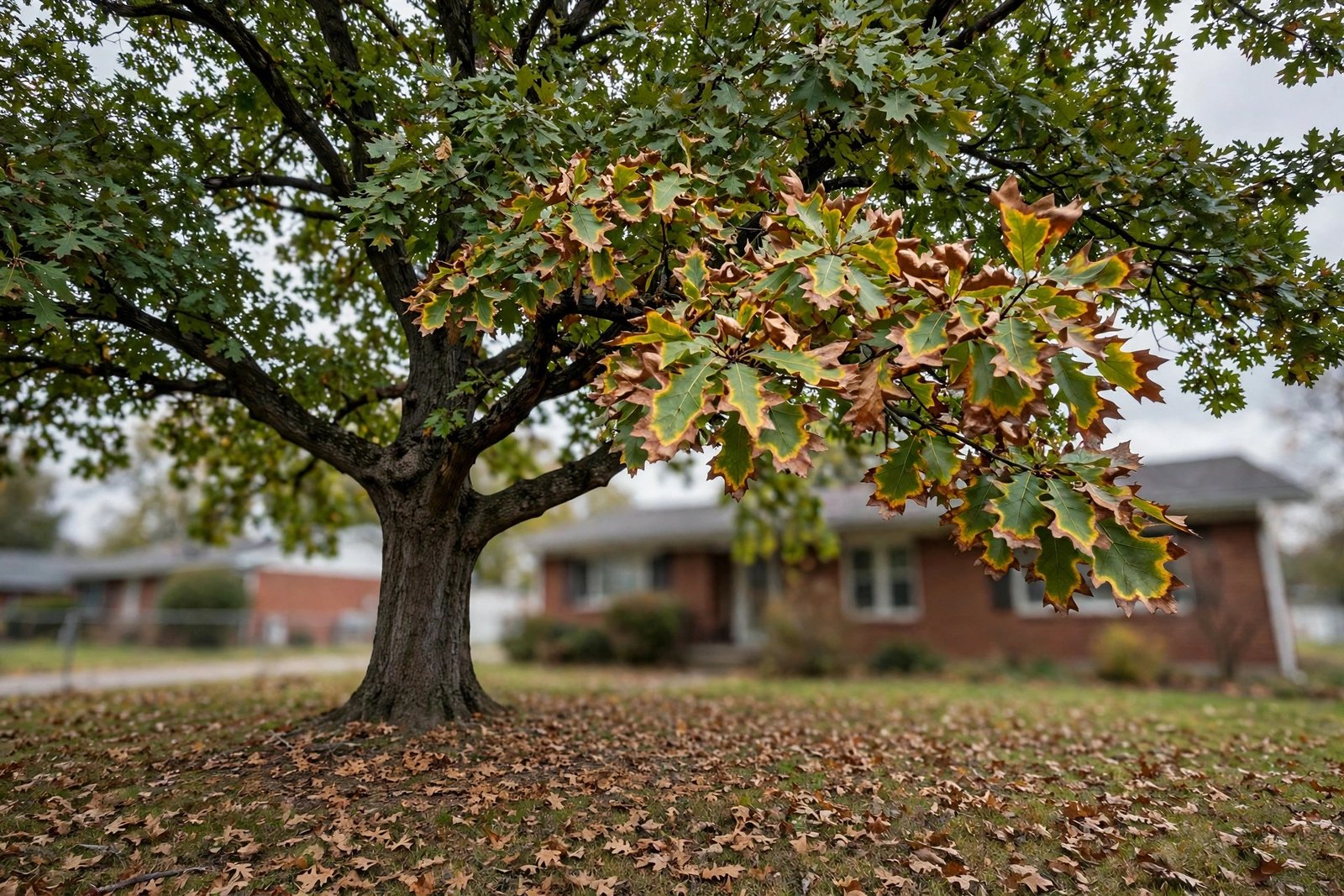
- Signature sign: leaf margins turning brown, often with a yellow or reddish-brown border, starting on one branch or section.
- How it spreads: leafhoppers and spittlebugs carry the bacteria from tree to tree as they feed.
- Speed: a slow, multiyear decline — infected trees usually die in about 3 to 6 years.
- No cure exists: nothing removes the bacteria; management is support, sanitation, and resistant replanting.
- Diagnosis: laboratory testing only, through the University of Illinois Plant Clinic, best done in late August or early September.
What Bacterial Leaf Scorch Actually Is
Bacterial leaf scorch starts where you cannot see it — inside the tree’s water pipes. The bacterium Xylella fastidiosa lives in the xylem, the tissue that carries water from the roots to the leaves. As the bacteria multiply, they clog those pipes, and the leaves at the far end of the line run short of water. Their edges dry out and die.
It is the same bacterium behind Pierce’s disease in grapes. In Illinois trees it is a slow killer: an infected oak leafs out normally every spring, scorches by midsummer, and leafs out normally again the next year — with the scorch returning on the same branches, a little worse each time. The University of Illinois Extension’s guide to bacterial leaf scorch of shade trees describes exactly that cycle.
The slow pace is what makes this disease easy to live with for a year too long. A tree that looks fine in May can have half its crown scorched by September, and the decline stretches over three to six years — a little thinner, a little browner, a little earlier each autumn. Drought browns a whole crown at once and eases after rain. Bacterial leaf scorch starts on one branch, then spreads through the crown over successive seasons. The pattern is the diagnosis, and November is when you can finally see it.
Which Peoria Trees Are at Risk
Oaks are the headline host in Illinois, and Peoria yards are full of them. The Extension says oak seems to be the most common host species in the state, and it has confirmed the disease on pin, red, shingle, bur, and white oaks. In one summer it confirmed six cases on pin oaks in central Illinois, plus a case on a shingle oak in Springfield. Pin oaks line countless Peoria streets and front yards — the same tall, straight-trunked trees that shade houses off War Memorial Drive, Knoxville Avenue, and Sheridan Road. Red oaks anchor the big lots around Bradley Park and Grandview Drive. If you have an oak, this disease belongs on your watch list.
It is not only oaks. The Extension’s Illinois host list also includes elm, sycamore, London plane, sweetgum, hackberry, ginkgo, and sugar and red maple — sycamores along the Illinois River bottoms included. The maples matter most: a sugar or red maple is itself a host, so planting one where a scorched oak stood is not the safe move it looks like. Conifers are not hosts at all, which is worth remembering for the replanting section at the end.
The Signs: Brown Margins, Yellow Halos, One Branch at a Time
Bacterial leaf scorch has a tell, and it shows up on a schedule. The first noticeable symptom is premature browning of the leaves in midsummer. Not spring — the tree leafs out fine. The browning starts in July or August, then gets worse through late summer and fall.
Look at the leaf itself. The margins turn brown first, and the brown creeps inward from the edge toward the veins. Often there is a border between the dead brown tissue and the living green — a band of yellow, or a reddish brown. Sometimes the scorch shows up between the veins instead of along the edge. Either way, the leaf looks burned around the outside while the middle is still trying to be green.
Now look at which leaves. The older leaves are usually affected first, and the damage moves outward along the branch toward the tip. The symptoms show on one branch, or one section of branches, all at once — not scattered randomly through the crown. That is the pattern that separates this disease from a hot week. A heat-stressed tree scorches all over. A bacterial leaf scorch tree scorches in one place, then another, then another, year after year.
Then there is the timing of the leaf drop. In most infected species the scorched leaves hang on until autumn. Oaks are the exception: an infected oak drops its leaves early, about a month ahead of the healthy oaks around it. If your pin oak was bare in early October while the neighbor’s still held its leaves into November, that is a data point. The Extension puts it plainly: a slow but progressive decline, scorch each July and August, and leaf drop about a month ahead of healthy oaks — that combination means bacterial leaf scorch may be present.
This is why November is the reading month. The leaves are down, and the pattern is written in the bare branches: which limbs dropped early, and how much of the crown is gone compared with last year. Walk the tree this week, limb by limb. If the signs line up, the next step is a lab test — the section below explains when to take it.
Bacterial Leaf Scorch vs. Oak Wilt vs. Drought Stress
Three different problems can all make an oak look brown, and the Extension warns that bacterial leaf scorch is easily confused with drought stress, cultural problems, cankers, and — in oaks — oak wilt. Getting it wrong costs you the tree, or costs you a healthy tree you cut down for nothing.
| Bacterial leaf scorch | Oak wilt | Drought stress | |
|---|---|---|---|
| Cause | Bacterium (Xylella fastidiosa) | Fungus (Bretziella fagacearum) | Lack of water |
| Speed | Slow — 3 to 6 years | Fast — weeks to a season for red oaks | Days to weeks, improves with rain |
| Pattern | One branch or section, spreading year to year | Whole crown wilts fast, often from the top | Whole crown evenly |
| Leaf look | Brown margins with yellow or reddish border | Leaves wilt, brown from the edges, drop fast | Leaves wilt, curl, brown all over |
| Leaf drop | Oaks drop about a month early | Heavy, sudden leaf drop | Leaves may hold on, then drop |
| Spreads to neighbors? | Slowly, by leafhoppers and spittlebugs | Fast, through root grafts and beetles | Does not spread |
| Cure | None | None | Water |
The speed column is the one to memorize. Oak wilt can take a red oak in a single season; bacterial leaf scorch takes years. If your oak has thinned a little more every autumn for three years running, that is the slow disease. The oak wilt post covers the fast disease, and the verticillium wilt post covers a third wilt disease that works through the soil.
Drought is the one you can rule out yourself. Water the tree deeply during a dry spell and watch. A drought-stressed oak perks up. A bacterial leaf scorch oak does not, because the problem is not the water in the soil — it is the water that cannot get through the pipes. If you have already read the signs your tree is dying guide, add this disease to its checklist: the one-branch pattern plus the early leaf drop is the combination that points here.
How It Spreads, and How to Get a Real Diagnosis
The bacteria cannot fly or blow on the wind. They ride: leafhoppers and spittlebugs carry Xylella fastidiosa from tree to tree when they feed on the soft shoots at the branch tips. The disease moves slowly through a neighborhood, one insect meal at a time — nothing like oak wilt, which travels underground through grafted roots in weeks. There is no spray that stops it, and pruning an infected branch does not cure the tree, because the infection is systemic: it is in the water-conducting tissue throughout the tree, not only in the branch that looks worst.
Only a laboratory test confirms bacterial leaf scorch. The symptoms overlap with drought, cankers, and oak wilt closely enough that no honest arborist will call it from a photograph alone. The University of Illinois Plant Clinic runs an antibody test that detects Xylella fastidiosa in symptomatic tissue.
Timing is everything, and this is the part most homeowners miss. The Clinic offers the test once a year, in late August or early September, when the bacterial population in the tree is at its highest. A sample taken in spring or early summer can come back negative even when the tree is infected, because there are not enough bacteria in the tissue yet for the test to find. That false negative is worse than no test at all — it tells you the tree is fine when it is not. The Extension’s bacterial leaf scorch of oak page states it directly: the best time to test is late summer or early fall, when the bacteria count is at its highest.
So if you are reading this in November, the testing window for this year has already closed. Photograph the scorched leaves and which branches were hit, while the evidence is still visible in the fallen leaves and the bare crown. Note the dates: when the browning started, when the leaves dropped, how this year compared with last year. Then mark late August on next year’s calendar and take the sample then, from a branch that still has scorched leaves attached. A professional tree inspection before then can confirm the pattern fits and rule out the faster-moving problems that cannot wait until August.
What You Can Do When There Is No Cure
There is no cure for bacterial leaf scorch. No fungicide, no antibiotic, and no cultural practice removes the bacteria from an infected tree. That sentence belongs near the top of any honest post about this disease, because the internet is full of products that promise otherwise.
What you can do is buy the tree time. A tree with a mild infection and a strong root system can live with this disease for years. The work is stress reduction: water deeply during dry spells, so the tree is not fighting drought and a clogged water system at once, and mulch 2 to 4 inches deep under the canopy, kept off the trunk. The tree pest and disease decision framework walks through the same treat-or-remove logic for other infections: the question is not whether the tree can be cured, but whether it is still safe, still useful, and still worth the space it occupies.
Prune out the dead wood in the dormant season — late fall through early spring, when the tree is bare and the insects that carry the bacteria are not active. Dead branches over a roof, driveway, or sidewalk are a hazard whether the tree is sick or not, and November is a good month to take them down: the leaves are off, the crew can see the crown, and the ground is still workable before the deep freeze. The tree disease treatment post explains how assessment works when you are deciding between support and removal, and the fall deep-root fertilization post covers feeding a stressed tree through winter.
Some arborists offer trunk-injected antibiotics that can suppress symptoms for a season or two, but they do not cure the infection — a decision to talk through with an arborist who has seen the tree. For a young tree with a mild infection, suppression plus good care can stretch its useful life by years; for a large oak already half bare, the same money is usually better spent on removal and replacement.
When Removal Is the Right Call
Removal is the right call when the tree is dead, when most of the crown is gone, or when a leaning, hollow, or structurally failed tree has become a hazard to the house, the driveway, or the sidewalk. Bacterial leaf scorch rarely makes a tree fall over on its own — it kills branches, and dead branches are what fall. An oak that has lost half its crown over three or four years is a tree with a lot of dead wood over a roof, and that is a removal decision, not a treatment decision.
The when to remove a tree guide covers the hazard signs that tip any sick tree from “watch it” to “take it down,” and the tree removal service page covers what the job itself involves. November is a reasonable month to do it: the leaves are down and the crew can see the crown. Get the diagnosis first — a confirmed case leaves you the whole winter to plan the removal and the spring to plant the replacement.
What to Plant Instead
The replacement matters more than the removal, because the wrong replacement is the next victim. The bacteria live in the tree, not in the soil the way verticillium wilt does, so you are not fenced out of the same spot for years. But planting another red-oak-group tree where a scorched oak stood is planting the next host in the same insect flight path.
Extension guidance points to species that are not hosts: hackberry, linden, and tulip poplar, along with disease-resistant elm cultivars — and conifers are not hosts at all. Do not reach for a maple as the “safe” choice: sugar and red maples are on the host list themselves. And do not plant another pin oak because it is what was there before. The best replacement trees guide covers the wider choice for Peoria yards, and the planting-distance guide covers how far the replacement should sit from the house, driveway, and sidewalk.
Before you buy, check the host list with the Plant Clinic or your arborist. A resistant species in the wrong spot — too close to the house, under a power line, in a wet corner — is still the wrong tree. The right replacement is resistant and the right size for the space, and it goes in the ground in spring.
Frequently Asked Questions
Can bacterial leaf scorch be cured?
No. There is no cure. Management is support and sanitation: water and mulch to reduce stress, prune out dead wood in the dormant season, and replant with a species that is not a host. Trunk-injected antibiotics can suppress symptoms for a season or two in some trees, but they do not remove the bacteria.
How do I know if my oak has bacterial leaf scorch or just drought stress?
Drought scorches the whole crown evenly and improves after deep watering. Bacterial leaf scorch starts on one branch or section, the brown margins often have a yellow or reddish border, and it comes back on the same branches every year — with the oak dropping its leaves about a month ahead of healthy oaks. Only a Plant Clinic lab test confirms it.
Will bacterial leaf scorch spread to my other trees?
It spreads slowly, carried by leafhoppers and spittlebugs from tree to tree. Nearby host species — another oak, a maple, a sycamore — can pick it up over the seasons. Non-host species and conifers in the same yard are not at risk.
When should I test my tree for bacterial leaf scorch?
Late August or early September, when the bacterial population is highest. The University of Illinois Plant Clinic offers the antibody test once a year in that window. A test taken in spring or early summer can give a false negative, so do not test early and trust a negative result.
What can I plant where a scorched oak stood?
A species that is not a host — hackberry, linden, tulip poplar, a disease-resistant elm, or a conifer. Do not plant another oak from the red oak group, and do not plant a sugar or red maple as the “safe” replacement, because maples are hosts too. Confirm the choice with the Plant Clinic or your arborist before you buy.
Read Your Oaks Before Winter Sets In
Bacterial leaf scorch is the slowest of the wilt diseases in Peoria, and the easiest to live with for a year too long. It does not kill in a season like oak wilt can, and it does not arrive on beetles like Dutch elm disease. It sits in the water pipes, takes a branch, waits, and takes another.
Walk your oaks this week. Look for the brown margins with the yellow border, the one-branch pattern, and the early leaf drop. Photograph what you see, mark late August on next year’s calendar for the test, and plan the winter around what the tree is telling you.
Peoria Tree Removal Co. — 114 W Forrest Hill Ave, Peoria, IL 61604 — (309) 250-8333 — https://treeremovalpeoriail.com/
Peoria Tree Removal Co.
114 W Forrest Hill Ave, Peoria, IL 61604
Mon–Sat 8am–6pm · 24/7 emergency tree service