
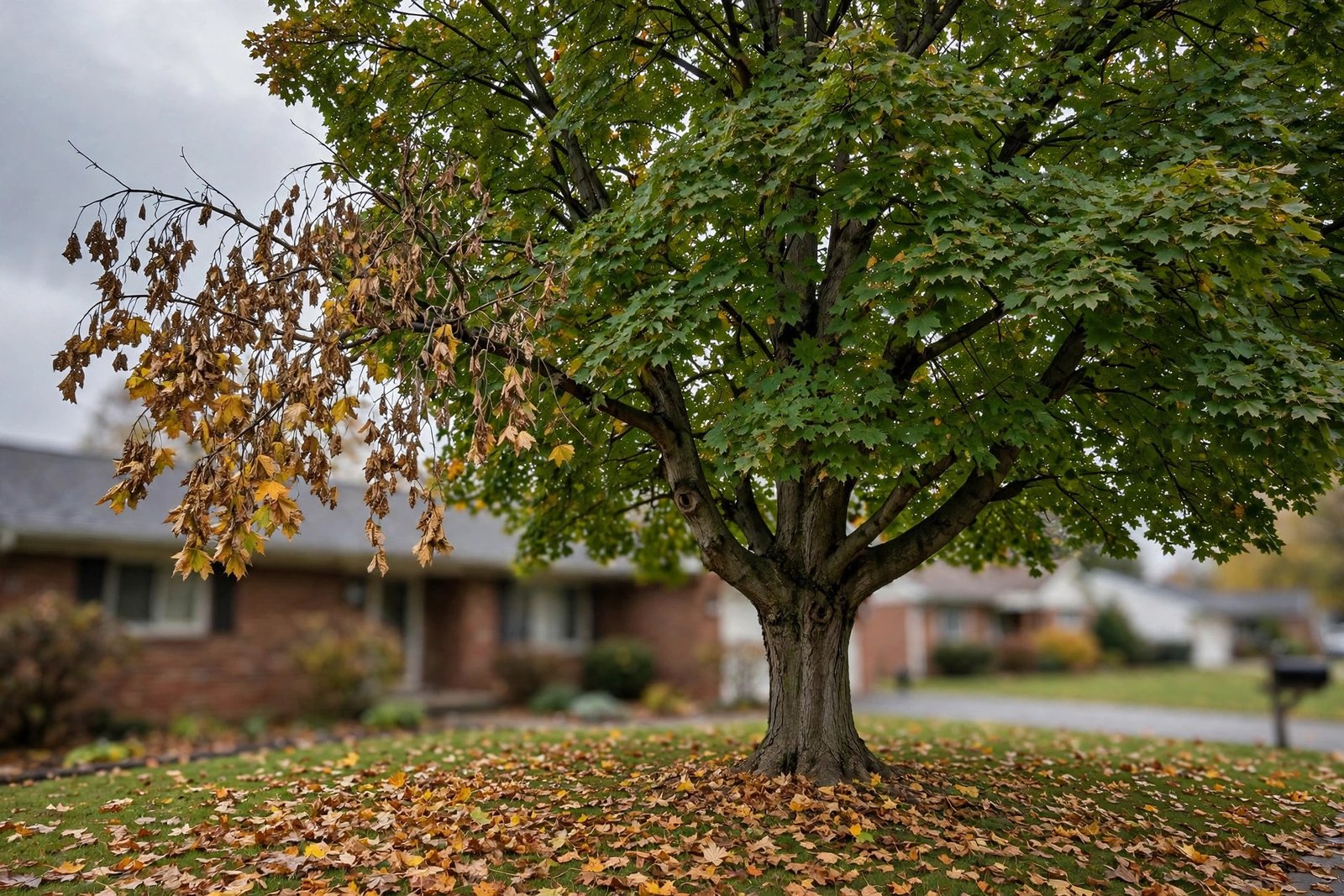
Verticillium wilt is a soil fungus that plugs a maple’s water pipes from the roots up — and November is the month to read it, because the flagged branches are now bare.
Verticillium wilt is a soilborne fungal disease that is fairly common in Illinois and kills maples, redbuds, and ash branch by branch. There is no cure, but a correct diagnosis changes everything: it tells you whether to nurse the tree, prune it, remove it, or simply never plant the same species in that spot again.
Quick Facts
- The disease: verticillium wilt, caused by the soil fungi Verticillium dahliae and Verticillium albo-atrum.
- Where it occurs: fairly common in Illinois, per the University of Illinois Extension; the U of I Plant Clinic confirms cases every year.
- Hosts: 300+ woody and herbaceous species, including maple, ash, elm, redbud, smoke tree, tulip tree, and red oaks.
- Signature sign: flagging — one branch, or one side of the tree, suddenly wilts and dies while the rest looks fine.
- How it spreads: through the soil and the roots, not on the wind.
- Speed: a highly susceptible tree can die in one season, but most decline over a few years — and some recover.
- No cure exists: no fungicide or cultural treatment removes it; management is support, sanitation, and resistant replanting.
- The replanting rule: wait 3+ years before planting a susceptible plant in the infected spot, and never plant back into the same hole.
What Verticillium Wilt Actually Is
Verticillium wilt starts where you cannot see it — in the soil, at the roots. Two related fungi, Verticillium dahliae and Verticillium albo-atrum, live in the ground for years as tough resting structures. They enter through stressed roots, colonize the water-conducting tissue, and plug it. The tree makes gums and tyloses to wall the fungus off, and those defenses plug the pipes further. The result looks like drought even when the soil is wet: leaves wilt because water cannot reach them.
That is what separates this disease from almost every other problem a Peoria maple can have. A drought-stressed tree wilts all over and perks up after a good rain. A verticillium-infected tree wilts on one branch, or on one side, while the rest of the crown carries on. The fungus moves up from the roots through individual vessels, so the damage follows the plumbing, not the weather. Infected dead roots help it survive in the soil for several years, even after the tree above is gone — which is why a new maple planted in the same hole is walking into the same problem.
Which Peoria Trees Are at Risk
Maples are the headline host in central Illinois, and Peoria yards are full of them. The Plant Clinic sees this disease most often in maple, redbud, smoketree, ash, magnolia, and catalpa. In one season it confirmed five cases in woody ornamentals — four Japanese maples and one redbud. Sugar maple, red maple, and silver maple are all susceptible. That matters here, because silver maples line so many older Peoria streets off War Memorial Drive and Knoxville Avenue, and Japanese maples are the small ornamental tree of choice in front beds from Peoria Heights to Morton.
It is not only maples. The common woody hosts in Illinois include ash, elm, redbud, smoke tree, tulip tree, and oaks in the red oak group. Red oaks are already the trees to watch for oak wilt, and they are also on the verticillium host list — so a red oak losing branches could be either disease, and only a laboratory test tells you which.
Some trees are not on the list. Conifers — pine, spruce, fir — are not hosts. White birch is not susceptible; the Extension’s own advice to one homeowner was that their sugar maple was susceptible but their white birch should be fine. Ginkgo is widely listed as resistant. Keep those names in mind for the replanting section at the end of this post.
The Signs: Flagging, One-Sided Wilt, and the Green Streak
Verticillium wilt has a tell. The Extension calls it flagging: the foliage on an individual branch suddenly wilts and dies. Not the whole tree — one branch, or one side of it. The leaves on that branch may yellow first, redden between the veins, or curl and die while still attached. Some hosts defoliate while the leaves are still green. Ash does this, which looks alarming and is easy to misread as a sudden shock.
Timing is the second tell. In Illinois, wilting symptoms usually start in early July, but they may begin as early as March and continue through November, when the leaves drop. The disease is worst in cool-to-warm weather and less prevalent in hot weather. A maple can look rough in June, steady through a hot August, and flag again in September. If your tree wilted on one side in July and you wrote it off as heat, look at it again now: the flagged branches held brown leaves all summer and are bare first this month.
Chronic cases look different. A tree living with the fungus for a year or two shows stunted, pale foliage, leaf scorch, slow growth, dieback of shoot tips, and sometimes an abnormally heavy crop of seed.
Then there is the test you can do with a pocketknife. Peel the bark back on a wilting branch and look at the sapwood. In most hosts the wood is streaked — light to dark green in maple, magnolia, and sumac; dark reddish brown in black locust; yellowish brown in cherry and smoke trees. Cut the branch across and the discoloration may show as a ring. Ash is the exception: internal discoloration shows up only about 5 percent of the time, so a clean-looking ash branch proves nothing. A green-streaked maple branch is strong evidence. Photograph it before you prune it off.
Do not jump from one flagged branch to a death sentence. A tree with only a few wilted branches may get worse next year, may recover and show no more symptoms, or may not show symptoms again for several years. Some trees live with this fungus. Some do not.
Verticillium Wilt vs. Oak Wilt, Dutch Elm Disease, and Drought
Peoria now has three wilt diseases in the conversation, and they are easy to mix up. The table below sorts them.
| Feature | Verticillium wilt | Oak wilt | Dutch elm disease |
|---|---|---|---|
| Cause | Soil fungi Verticillium dahliae / V. albo-atrum | Fungus Ceratocystis fagacearum | Fungi Ophiostoma novo-ulmi / O. ulmi |
| Main Peoria hosts | Maple, redbud, ash, elm, smoke tree, red oak | Oaks, red-oak group dies fastest | Elms, American elm most vulnerable |
| How it spreads | Through soil and roots | Root grafts + sap beetles to wounds | Elm bark beetles + root grafts |
| First sign | One branch or one side flags | Top-down wilting, leaves brown from margins | Yellow leaves on one or more branches, flagging |
| Sapwood streak | Green in maple; brown ring possible | Brown or black streaking | Brown streaks in sapwood |
| Speed | Usually years; sometimes one season | Red oaks die in one season | Spring infection can kill the same season |
| Pruning rule | Prune dead wood any time; sterilize tools | Only November to early April | Dormant season for infected wood |
| Replanting rule | Wait 3+ years; resistant species only | Avoid oaks near infected trees | Plant a non-elm or resistant elm |
Drought is the fourth lookalike and the one that causes the most wasted removals. A drought-stressed tree wilts across the whole crown and recovers after rain or a deep watering. Verticillium wilt stays on its branch or its side no matter how much you water. If you watered all summer and one side of the maple still looks dead, watering was never the problem. The signs of a dying tree are worth reading beside this post: one asks whether the tree is in trouble, the other asks what kind of trouble it is. The oak wilt guide and the Dutch elm disease guide are companions to this one.
What to Do Now — November Is the Reading Month
November is not the month verticillium wilt shows up. It is the month you can finally read it. The leaves are falling, the flagged branches that held brown foliage all summer are now bare twigs against the sky, and the shape of the damage is visible in a way it never is in July. Walk your maples this week and look at each one from two sides. A tree that flagged on one side will show it plainly now: bare branches on the left, a full crown on the right.
Get the diagnosis confirmed before you spend money on anything. A sample of a symptomatic branch — one with yellowing or wilting leaves that are not completely dead — can be sent to the University of Illinois Plant Clinic, which confirms the fungus in the laboratory. Submission details are on the University of Illinois Extension verticillium page, the source for the facts in this post. A professional tree inspection is the other route: an arborist reads the crown, does the streak test, and takes the sample for you. Do not remove a tree on a guess. A maple that flagged once can recover, and a maple that is actually infected needs a plan, not a panic cut.
While you wait, do the things that help a stressed tree and hurt nothing. Water during dry spells that last more than a couple of weeks — Peoria’s first frost usually falls between October 11 and 20, so the ground is still workable in November. Mulch lightly around the base, kept off the trunk. Fertilize in the fall if the tree needs it, using a fertilizer lower in nitrogen and higher in potassium, the Extension’s recommendation for early-symptom trees. The fall deep-root fertilization post covers the timing. Prune out the wood that is actually dead — not the wilted branches, which may recover, but the branches that are dead and dry. Sterilize your tools between cuts, and between that tree and the next healthy tree you prune.
Can a Tree With Verticillium Wilt Be Saved?
The honest answer is: sometimes, partly, and never by a spray. There are no proven cures, chemical or cultural. No fungicide available to homeowners treats it, and the Extension is blunt about that in every one of its verticillium publications.
What can help is vigor. A tree with early symptoms — a few wilted branches, not half the crown — should be watered and fertilized, and the dead wood pruned out. The Extension’s advice is to leave wilted branches in place for a while rather than cutting them the moment they flag, because a wilted branch can recover with fertilization and watering. Wilted is not dead. Dead is dead. Prune the dead wood, support the wilted wood, and watch what comes back in spring.
Some infected trees show symptoms one year and none the next. Others get worse the following year. Keep a simple record — a photo each July, a note of which branches flagged — because memory is a poor diagnostic tool and a dated photo series is a good one.
What does not help: piling on high-nitrogen fertilizer, wounding the roots with a rototiller, planting a new maple in the same hole, or chipping the dead wood and spreading it around the yard as mulch. The Home, Yard & Garden guidance is specific: dead wood from a verticillium-infected tree should be burned, not chipped and reused in the landscape. Peoria does not allow open burning of yard waste, so bag it for the city’s yard-waste collection or haul it to a green-waste site.
What to Plant Instead
This is where verticillium wilt differs from oak wilt and Dutch elm disease, and where most homeowners get the next step wrong. With oak wilt, the danger is the neighbor’s oak. With Dutch elm disease, the danger is the beetle. With verticillium wilt, the danger is the soil itself — and the soil stays dangerous after the tree is gone. Planting another maple in the same hole is planting the next victim.
The rule, from the Extension, is to wait three or more years before growing a susceptible plant in the infected area, and never to plant back into the same hole. That is a long wait for a front yard with a gap in it, which is why the replacement choice matters more than the waiting: plant something that is not a host at all, and the wait stops mattering.
Good replacements include conifers, which verticillium wilt does not attack — a spruce or fir where a maple stood changes the look of the bed, but it will not die the same way. White birch is not susceptible. Ginkgo is widely listed as resistant and handles Peoria’s clay soil and zone 6a winters well. Hawthorn fits a smaller yard. Before you buy, check the resistant list in the University of Illinois Report on Plant Disease No. 1010, or ask the Plant Clinic for its verticillium fact sheet. The planting-distance guide covers how far the replacement should sit from the house, driveway, and sidewalk.
One more caution: the fungus also infects vegetables, fruits, and herbaceous plants. If the dead maple stood at the edge of a vegetable bed, do not put tomatoes, potatoes, or strawberries in that soil either — they are famously susceptible, and the same three-year rest applies.
When Removal Is the Right Call
Removal is the right call when the tree is dead, when most of the crown is gone, or when a leaning, hollow, or structurally failed tree has become a hazard to the house, the driveway, or the sidewalk. Verticillium wilt rarely makes a tree fall over on its own — it kills branches, and dead branches are what fall. A maple that has lost half its crown over three years is a tree with a lot of dead wood over a roof, and that is a removal decision, not a treatment decision.
The removal itself has one rule the Extension states plainly: take the tree out with as much of the root system intact as possible. Infected dead roots left in the ground keep the fungus alive in the soil. The when to remove a tree guide covers the hazard signs that tip any sick tree from “watch it” to “take it down,” and the tree disease treatment post explains how assessment works.
November is a reasonable month to do it. The leaves are down, the crew can see the crown, the ground is still workable before the deep freeze, and there is no beetle or spore season to worry about. What is fenced in is the replanting: the new tree goes in a different spot, or a resistant species goes in after the soil has rested. Get the diagnosis first. A confirmed case in November leaves you the whole winter to plan the removal and the spring to plant the replacement.
Frequently Asked Questions
Can verticillium wilt be cured?
No. There are no proven chemical or cultural cures. Management is support and sanitation: water and fertilize early-symptom trees, prune out dead wood, sterilize tools, remove dead trees with as much root as possible, and replant with resistant species.
How do I know if my maple has verticillium wilt or just drought stress?
Drought wilts the whole crown evenly and improves after watering. Verticillium wilt flags one branch or one side while the rest looks fine, and watering does not fix it. The streak test supports the diagnosis, and the University of Illinois Plant Clinic confirms it from a sample.
Will verticillium wilt spread to my other trees?
It spreads through the soil and roots, not through the air. Nearby susceptible trees — another maple, a redbud, an ash — can pick it up through their roots, especially if stressed or wounded. Resistant species and conifers in the same yard are not at risk.
Should I cut off a wilting branch right away?
Not immediately. Wilted branches may recover with fertilization and watering, so give them a chance. Prune out wood that is actually dead, sterilize tools between cuts, and dispose of the dead wood rather than chipping it back into the landscape.
What can I plant where a verticillium-killed tree stood?
A resistant species — conifers, white birch, ginkgo, or hawthorn — or wait three or more years before planting anything susceptible, and never plant back into the same hole. Check the University of Illinois resistant list before you buy.
Read Your Maples Before Winter Sets In
Verticillium wilt is the quietest of the three wilt diseases in Peoria, and the easiest to live with for a year too long. It does not kill in a season like oak wilt can, and it does not arrive on beetles like Dutch elm disease. It sits in the soil, takes a branch, waits, and takes another.
Walk your maples this week. Look for the one-sided pattern, do the streak test on a flagged branch, and send a sample to the Plant Clinic if the signs line up. If the tree is dead or hazardous, take it down with the roots. And when you plant again, plant something the soil cannot kill.
Peoria Tree Removal Co. — 114 W Forrest Hill Ave, Peoria, IL 61604 — (309) 250-8333 — https://treeremovalpeoriail.com/
Peoria Tree Removal Co.
114 W Forrest Hill Ave, Peoria, IL 61604
Mon–Sat 8am–6pm · 24/7 emergency tree service