
Tree health care is the routine, scheduled care that keeps your trees healthy enough to stay — inspections, soil work, pruning, and pest checks on a plan, instead of a removal quote after something goes wrong.
Most Peoria homeowners only call a tree company twice: once when a branch falls, and once when a tree has to come down. Tree health care is the work that fills the gap in between — a scheduled program of inspections, soil and root checks, pruning at the right time, feeding only when the soil needs it, and pest and disease monitoring before a small problem becomes a dead tree. This post explains what it covers, how it differs from a one-off trimming or a removal, what a year of it looks like in central Illinois, and how to tell a genuine care plan from a sales pitch.
Quick Facts
- Tree health care is proactive, not reactive: the point is to catch problems while they are still cheap — a treatment now instead of a removal later.
- It starts with an inspection, not a spray: a real plan begins by looking at each tree, checking the soil, and finding what each tree actually needs.
- Most properties need a check at least once a year: mature trees and trees near the house benefit from an annual inspection, with extra visits after big storms.
- Feeding is not automatic: fertilizer helps only when a soil test shows a real deficiency.
- It does not replace pruning or removal: health care reduces how often you need the big jobs, but a hazardous tree still needs to come down.
- Spraying is a last resort, not a routine: good plans use targeted treatments for a diagnosed problem, not blanket sprays on a calendar.
What Tree Health Care Actually Is
Plant health care — the industry term is PHC — is a simple idea with a disciplined method behind it. Instead of waiting for a tree to show obvious trouble, an arborist visits on a schedule, looks at every tree on the property, and treats only what each tree actually needs. The International Society of Arboriculture describes the core of it as diagnosis first: tree biology, soil conditions, pests, and structure are assessed before any treatment is recommended. A plan that starts with a treatment and looks for a reason afterward is not health care. It is a sales route.
Think of it the way you think about a car or a roof. You do not wait for the engine to seize before changing the oil. Trees work the same way, only slower. A maple with girdling roots will look fine for years while the roots quietly strangle the trunk. An oak with early oak wilt will show a few scorched leaves at the top in June and be bare by August. A spruce with bagworms will carry a few small bags in July and be half-defoliated by September. In every case, the cheapest moment to act was months before the problem became obvious from the street. Scheduled health care is how you buy that earlier moment.
That is also why health care is a program rather than a single service. One visit can find a problem. A program makes sure someone is looking again next season, when the problem you fixed has either stayed fixed or come back, and when a new problem has had time to appear. The trees that benefit most are the ones you most want to keep: the big shade oak over the patio, the maple that shades the front of the house, the row of arborvitae that screens the neighbors. Those are also the trees whose loss would cost the most — in removal expense, in shade and property value, and in the decades it takes a replacement to grow back.
What a Tree Health Care Visit Actually Includes
A genuine health care visit is mostly looking, measuring, and asking questions. The treatment, when there is one, is the smaller part of the day.
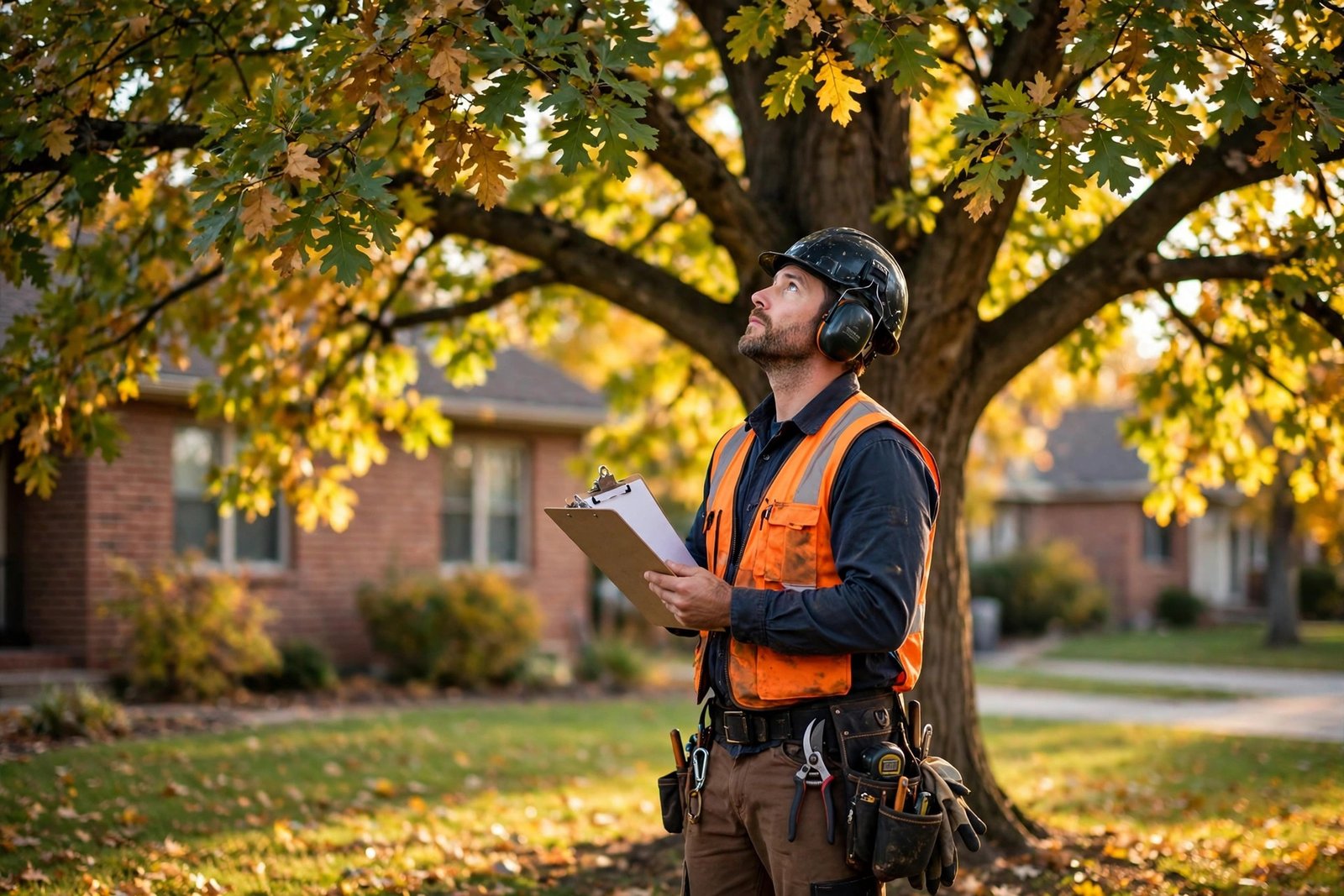
A whole-tree inspection, roots to crown. The arborist starts at the base and works up. The trunk flare — the widening where the trunk meets the roots — should be visible, not buried under a mulch volcano or piled soil. Roots circling the base, mushrooms near the trunk, and soil that stays soggy or is baked hard all get noted. Up the trunk, the check is for seams, cankers, and bark peeling in sheets. In the crown, the arborist looks at leaf size and color, dieback at the branch tips, and whether growth is even all around — uneven growth often points to a root problem on one side or an old pruning mistake. This is the same kind of assessment described in our guide to professional tree inspection, done on a schedule instead of once after a scare.
A soil and site check. Trees do not decline in a vacuum. Compacted soil from a new driveway, a grade change from landscaping, a downspout dumping water at the trunk, or a summer of drought all show up in the canopy months later. A health care visit looks at how water drains, whether the soil is compacted, whether mulch is piled against the trunk, and whether the tree is getting enough water in dry spells. Where the picture is unclear, a soil test shows pH and nutrient levels, so any feeding is aimed at a real deficiency instead of a guess.
Pruning for health, not just shape. Health care pruning is light and specific: dead, dying, and diseased branches out; rubbing branches separated; a little clearance where limbs touch the roof. It is not heavy structural pruning, and it is not a size reduction. The work happens in the right season — dormant-season pruning for most species, and never pruning oaks in April, May, or June, when sap-feeding beetles can carry oak wilt into fresh cuts.
Pest and disease monitoring. Central Illinois has a short list of repeat offenders: emerald ash borer on ash, bagworms on arborvitae and spruce, oak wilt on red oaks, and the fungal problems that follow wet springs. A visit checks for the early signs — D-shaped exit holes and thinning crowns on ash, small silk bags on evergreens in early summer, scorched leaves starting at the top of a red oak — while there is still something to do about them. A treatment that works on a few bagworms in June is useless on a stripped evergreen in August. When something is found, the response is targeted tree disease treatment for that specific problem, not a blanket spray.
Feeding only when the soil says so, plus watering guidance. Deep-root fertilization helps when a soil test shows a deficiency or a tree is struggling in compacted, poor soil. A plan that fertilizes every tree on every visit, without ever testing the soil, is selling fertilizer, not health. The most common advice from a visit is also the least glamorous: water deeply and slowly at the dripline during dry spells, and keep mulch two to four inches deep and pulled back from the trunk. In Peoria’s zone 6a climate, with first frost usually arriving between October 11 and 20, fall watering matters — trees go into winter needing moisture in the root zone, and a dry fall is how evergreens come out of winter brown and scorched.
Health Care Is Not Trimming, and It Is Not Removal
Trimming and pruning are single interventions. You book them, a crew comes, branches come down, and the job is done. They are reactive by nature: you call because the maple is over the roof or the oak has deadwood. Health care is the program that decides when those interventions are needed, and whether a smaller fix would do instead. A tree on a care plan still gets pruned — but it gets pruned because an inspection found a reason, at the right time of year, by someone who knows the tree’s history. Our trimming versus pruning guide explains the difference between those two cuts in detail.
Removal is the end of the road. It is the right answer for a dead, structurally failed, or dangerous tree, and no care plan should ever talk a homeowner out of removing a tree that is genuinely hazardous. What health care does is shrink the number of trees that reach that point. When removal is the answer, it is the tree removal service that handles it — not the care plan.
| Job | What it is | When you book it | What it prevents |
|---|---|---|---|
| Tree health care | Scheduled inspections, soil checks, monitoring, targeted treatments | On a plan, at least once a year | Small problems becoming removals |
| Trimming / pruning | Cutting branches for clearance, shape, or health | When a specific branch problem appears | Overgrowth, deadwood hazards, roof contact |
| Removal | Taking a tree down entirely | When a tree is dead, hazardous, or unwanted | Damage, injury, liability |
| Inspection (one-off) | A single assessment of a tree’s condition | After a storm, before a sale, or on worry | Guessing wrong about a tree’s condition |
A Year of Tree Health Care in Peoria
Central Illinois gives trees a hard year: wet springs, hot and sometimes dry summers, the June 2024 derecho still fresh in local memory, ice storms in winter, and a first frost that usually lands between October 11 and 20.
| Season | What happens | Why it matters here |
|---|---|---|
| Late winter | Full inspection with leaves off; dormant-season pruning | Deadwood, cankers, and structural problems are all visible; oaks are safe to prune while oak wilt beetles are not flying |
| Spring | Watch how each tree leafs out; soil testing and feeding where needed; first pest checks | Late or one-sided leaf-out points to root trouble; bagworm eggs hatch in June, so evergreens get checked now |
| Summer | Deep watering in dry spells; storm-damage checks after big wind | Wilting and early leaf drop usually mean thirst, not sickness; a quick look after a storm catches cracked limbs before the next one |
| Fall | Deep-root feeding where the soil test supports it; watering until the ground freezes; mulch topped up | Trees that go into winter dry come out damaged, especially evergreens; the year’s notes get reviewed for next spring |
That rhythm — inspect in winter, watch in spring, water in summer, feed and water in fall — is the whole program. Nothing in it is exotic. The value is that someone is actually doing it, on a schedule, year after year.
The Signs Your Trees Need Health Care, Not Just a Trim
You do not need to diagnose your own trees. But it helps to know which signs mean “get someone out to look” rather than “book a trimming”:
- Thinning at the top. The crown is getting sparse from the top down, or one side is noticeably thinner than the other. Top-down thinning is the classic early sign of root trouble or disease.
- Leaves that are smaller, paler, or earlier to fall than the neighbors’ trees. A tree that turns color and drops leaves weeks before the same species across the street is stressed, and stress has a cause worth finding.
- Dead branches scattered through a living crown. A few dead limbs are normal. Deadwood through a third or more of the crown is a tree in decline.
- Bark changes. Bark peeling off in sheets, deep cracks, oozing, or fungal shelves growing on the trunk are all signs of internal decay or infection.
- Mushrooms at the base. Fungal fruiting bodies near the trunk or on major roots usually mean decay inside the tree, not a lawn problem.
- Leaning that is new or getting worse. A tree that leaned further after the last storm, or whose soil is heaving on one side, needs a risk assessment, not a wait-and-see.
Any one of these on its own is a reason for an inspection. Two or more together is a reason to stop waiting. And if the tree in question is the big one over the house, the driveway, or the kids’ play area, the cost of finding out is small next to the cost of being wrong.
What Tree Health Care Costs — and How to Spot a Sales Pitch
The honest answer on cost is that it depends on what your property actually needs — which is exactly why a plan starts with an inspection rather than a price list. A small lot with three healthy young trees needs far less than a half-acre on Grandview Drive with six mature oaks, a declining ash, and a row of arborvitae. The factors that move the cost are the number and size of the trees, how many visits the plan includes, whether soil testing is needed, and whether any treatment is actually required in a given year.
That variability is also why you should be careful with any quote that prices health care as a flat package before anyone has looked at your trees. A flat fee that includes spraying every tree four times a year is not a care plan. It is a spraying contract, and the trees are incidental. A real plan prices the inspection and the monitoring, and treats only what the inspection finds. Some years that means very little beyond the visit itself. That is a good year, not a wasted one — the visit is what tells you it was a good year.
A genuine plan is also easy to recognize. It starts with an inspection, not a treatment. Its recommendations name your species, your soil, and your problems — the silver maple with surface roots, the pin oak with early chlorosis, the arborvitae with bagworms — instead of reading the same for every house on the street. It treats only diagnosed problems, using integrated pest management: a specific pest, at the right time, with the least disruptive method that works. And it keeps records — each visit leaves notes on what was checked, what was found, and what to watch before the next visit. If there is no paper trail, there is no program. There are just visits.
If a company offers a free estimate, ask what the first visit includes, how often visits happen, what triggers a treatment, and what happens if a tree is found to be hazardous. The answers matter more than the number. Our guide to choosing a tree service covers the questions worth asking any company before you hire them.
Frequently Asked Questions
How often should my trees be checked?
Most residential properties benefit from a professional inspection at least once a year, with extra checks after major storms. Mature trees, trees near the house, and trees with a known problem may need two visits a year.
Is tree health care the same as tree trimming?
No. Trimming is a single job — cutting branches for clearance, shape, or safety. Health care is the ongoing program that includes inspection, soil checks, pest monitoring, and targeted treatments, and it decides when trimming is needed and when it is not.
Will health care save a dying tree?
Sometimes, if the problem is caught early and the cause is treatable — a pest, a nutrient deficiency, compacted soil. But no care plan can save a tree with advanced internal decay, a failed root system, or a disease that has already spread through the crown. The honest value of health care is that it finds the savable ones early and tells you plainly about the ones that are not.
Can I do tree health care myself?
Some of it, yes. Watering deeply in dry spells, keeping mulch off the trunk, and watching for the warning signs in this post are all things a homeowner can do well. What you cannot easily do yourself is diagnose a disease, read a soil test, or assess structural risk from the ground. The plan is the professional part. The daily care is yours.
Start With a Look, Not a Guess
Tree health care is not a luxury service for people with orchards. It is the ordinary maintenance that keeps the trees you already have — the ones shading the house on Knoxville Avenue, the oak over the patio in Peoria Heights, the maples along the lot line in Morton — standing for another twenty years instead of becoming next year’s removal. The cost of finding out what your trees need is a single inspection. The cost of not finding out is finding out later, when the options are fewer and the bill is bigger.
If you have a tree you are watching, or a yard full of trees you have never really had looked at, that is the place to start. Call Peoria Tree Removal Co. at (309) 250-8333 for a free estimate, and ask for a tree health assessment — what is healthy, what needs work, and what can wait. You will get an answer about your trees, not a sales pitch, and you will know where you stand before the next storm decides for you.
Peoria Tree Removal Co. — 114 W Forrest Hill Ave, Peoria, IL 61604 — (309) 250-8333 — https://treeremovalpeoriail.com/
Peoria Tree Removal Co.
114 W Forrest Hill Ave, Peoria, IL 61604
Mon–Sat 8am–6pm · 24/7 emergency tree service