
Winter Tree Care in Peoria, IL: How to Protect Your Trees Before the First Freeze
Winter tree care in Peoria, IL starts in October. The average first frost here lands between October 11 and 20, and after that, ice, heavy wet snow, and freeze-thaw cycles punish unprepared trees for the next five months. The short version: prune dead and weak limbs in late fall, mulch properly, water deeply until the ground freezes, wrap young thin-barked trees, and get risky trees evaluated before the first ice storm — not after.
After 17 years working on trees across Peoria County, we can tell you exactly which trees fail in January and February: the ones that went into winter with dead limbs, cracked bark, dry roots, or a lean nobody looked at. Every one of those problems is cheaper to fix in October than in an emergency call at 2 a.m. during an ice storm. Here is the full playbook.
Why October Is the Month to Act in Peoria
Peoria sits in USDA hardiness zone 6a, where winter lows can drop to around -10°F. The Illinois River valley funnels wind straight through neighborhoods in Bartonville, Peoria Heights, and along Grandview Drive, and central Illinois is no stranger to ice storms and heavy, wet early-season snow. Trees that go into winter with dead limbs, thin bark exposed, or dry roots are the ones that snap in January — and the ones that cost homeowners emergency removal fees in February.
The good news: fall is the best season to get ahead of all of it. Trees are going dormant, leaves are dropping so structural problems are easy to spot, and an arborist can see exactly what needs attention. A one-hour walkthrough in October can prevent a $2,000 emergency in January.
The Winter Pruning Window: What to Cut and When
Late fall through winter dormancy is the ideal pruning window for most trees in central Illinois. Without leaves, weak branch unions, cracks, crossing limbs, and dead wood are all visible, and cuts made now seal cleanly before spring growth begins. Dormant pruning also means less stress on the tree — it is not spending energy on leaves or fruit, so it can put everything into compartmentalizing the wound.
Oaks have one strict rule in our area: prune only between November and March. Oak wilt (Ceratocystis fagacearum) spreads through beetles active in the growing season, and a fresh pruning cut in April through July is an open invitation. If you have mature oaks — and plenty of Peoria Heights and Grandview Drive properties do — schedule them now, not in spring. Maples, lindens, ash, and most shade trees can also be pruned through the dormant season.
One exception: spring-flowering trees like crabapples (Malus spp.), redbuds (Cercis canadensis), and ornamental cherries (Prunus spp.) set their buds the previous year. Pruning them in winter means cutting off next spring’s flowers. Wait until just after they bloom. Everything else? Winter is prime time. Our tree trimming and pruning service runs year-round, but the dormant-season schedule fills fast — October and November appointments go first.
Protecting Young Trees From Freeze Damage
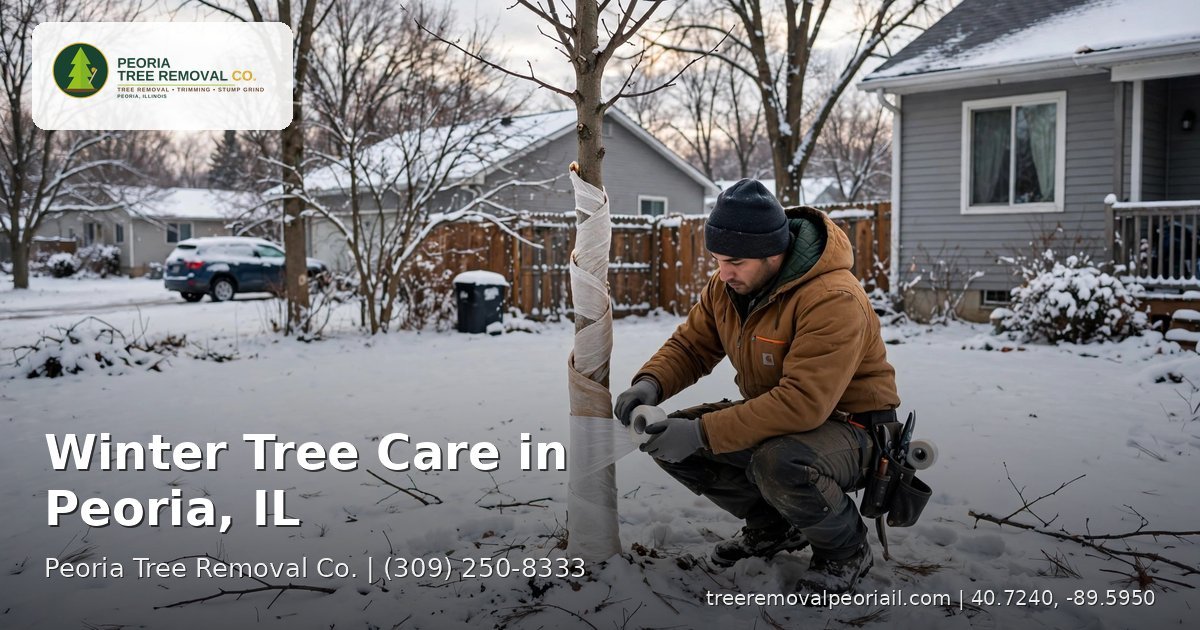
Newly planted trees and thin-barked species — maples, fruit trees, lindens, honeylocust — are prone to a winter injury called sunscald. On a bright January day, the sun warms the southwest side of the trunk; then temperatures crash after sunset and the bark cracks. Those cracks become entry points for decay and insects for the rest of the tree’s life.
The fix is simple: wrap trunks loosely with commercial tree wrap from the ground up to the first branches, starting in late fall — the Morton Arboretum has clear how-to guidance on winter tree protection if you want the details. While you are at it, add a plastic tree guard. Rabbits and mice chew bark all winter when other food is scarce, and a girdled young tree often does not survive. Remove wraps and guards in spring once the threat of hard freezes passes — leaving them on traps moisture and invites rot.
Evergreens need a different kind of protection. Winter burn happens when needles lose moisture to cold wind faster than frozen roots can replace it. The result is brown, scorched foliage by March. Water evergreens deeply before the ground freezes, mulch their root zones, and on the most exposed windy sides, a simple burlap screen staked a foot from the foliage breaks the wind without smothering the tree.
Ice-Storm Damage Prevention: Before and After
The June 2024 derecho was a wind event, but winter brings Peoria’s other tree-killer: ice. University of Illinois Extension research notes that ice can multiply a branch’s weight many times over — even a quarter inch of ice is enough to snap small branches and weak limbs. Weak branch unions split, evergreens splay and break under the load, and whole trees can uproot in saturated, thawing soil when wind follows the ice.
Prevention starts with structure. A professional pruning in fall removes the dead and weakly attached limbs most likely to fail, and for valuable trees with co-dominant leaders or heavy horizontal limbs, cabling and bracing hardware can add years of safe life. It is a fraction of the cost of a removal — and far less than the cost of a limb through a roof.
After an ice storm, resist the urge to knock ice off branches — we’ve watched homeowners do more damage with a broom than the ice did. Let it melt naturally, then walk the property and look for hanging broken limbs (widowmakers), fresh cracks, and new leans. Call an arborist before the next wind event, not after. Our certified arborist assessments cover exactly this kind of post-storm triage.
Winter Watering During Thaws
Most Peoria homeowners stop watering the day the leaves fall. That is a mistake. Trees keep losing water through bark and evergreen needles all winter, but frozen soil means roots cannot replace it. The result is winter desiccation — subtle, cumulative damage that shows up as dieback the following summer.
Give trees — especially evergreens and anything planted in the last two years — a long, slow soak in late October or early November, and keep watering during any stretch when the ground thaws and temperatures climb above 40°F. A soaker hose left running for a few hours on a mild December or January day does more good than most people realize. New plantings are the priority: their root systems are still confined to the original root ball and dry out fastest.
What NOT to Do to Your Trees in Winter
Winter mistakes kill more trees than winter weather does. Avoid these:
- Do not top your trees. Cutting a crown back to stubs to “reduce ice load” starves the tree, invites decay, and produces weakly attached watersprouts that snap in the first storm. Proper crown reduction is the only correct way to reduce size.
- Do not build mulch volcanoes. Piling mulch against the trunk traps moisture against bark, invites rot and rodents, and suffocates surface roots. Two to three inches in a wide ring, kept several inches off the trunk.
- Do not fertilize in fall or winter. Late-season nitrogen pushes soft new growth that the first hard freeze kills. If a tree needs feeding, early spring is the time.
- Do not prune oaks outside November–March. One April pruning cut can introduce oak wilt to a healthy tree. This rule is non-negotiable in central Illinois.
- Do not park snow piles on root zones. Piled snow laced with road salt dumps chloride directly onto roots as it melts. Keep plowed snow away from tree bases.
- Do not ignore a new lean. A trunk that was straight in October and leaning in February has a root problem. That tree needs an evaluation before the next storm, not after it falls.
Late-Winter Planning: Emerald Ash Borer and Oak Wilt
February and March feel like downtime, but they are planning season for the two biggest tree-health threats in Peoria County. Emerald ash borer (Agrilus planipennis) is confirmed here, and a dead ash standing through winter becomes a spring hazard — brittle wood plus snow load is a bad combination. Check ash trees for D-shaped exit holes, bark splitting, heavy woodpecker activity, and thinning at the top of the canopy.
If your ash is still mostly healthy, late winter is the time to plan treatment. Systemic trunk injections for EAB are applied in spring when the tree is actively moving sap — but the decision, the budgeting, and the scheduling happen now. A healthy ash worth saving should be on a professional’s calendar before April. An ash past the point of treatment should be scheduled for removal before it becomes brittle and dangerous.
Same logic for oak wilt: use the quiet months to inventory your oaks and get any needed pruning done inside the November–March safe window. Come April, the saws stay away from oaks until fall.
Is Winter a Good Time to Remove a Tree?
Yes — winter is often the best time. The tree is dormant, frozen ground protects your lawn from equipment ruts, crews can see the full branch structure, and scheduling is usually faster than in storm season. The one exception is during active ice or deep snow, when work gets dangerous and may need to wait a few days. If you have been putting off a removal, get a free estimate now instead of gambling through another winter. And if a tree has already failed, our emergency tree removal crew works through winter storms — though a planned November removal is always calmer and cheaper than a 2 a.m. January emergency.
Winter Tree Care Checklist for Peoria Homeowners
- Prune dead and weak limbs; schedule oaks for November–March only
- Mulch 2–3 inches deep in a wide ring, kept off the trunk
- Deep-water evergreens and new plantings until the ground freezes; water again during winter thaws
- Wrap young, thin-barked trunks; add rodent guards; remove in spring
- Inspect ash trees for emerald ash borer signs; plan spring treatment or removal now
- Walk the property: leaning trunks, cracks, limbs over structures, salt-heavy snow piles on roots
- After ice storms: let ice melt naturally, then get a professional inspection before the next wind
Which Peoria Trees Need Winter Protection Most?
Not every tree needs the same attention. In USDA zone 6a, with our freeze-thaw cycles and ice storms, here is where to focus:
| Tree | Winter risk in Peoria | Protection needed | Priority |
|---|---|---|---|
| Young / newly planted trees | Frost cracks, sunscald, rodent girdling | Trunk wrap November–March, wide mulch ring | High |
| Silver maple | Ice-load breakage — weak wood | Prune weak limbs in fall | High |
| Fruit trees | Frost damage to buds | Wrap, mulch, late-winter pruning | Medium |
| Evergreens | Winter burn, heavy snow load | Brush off heavy snow gently | Medium |
| Mature oaks | Generally hardy | Dormant pruning November–March only (oak wilt) | Low — but timing matters |
Your Peoria Trees: September to February
The fall-to-winter timeline that prevents most cold-weather damage
Walk every tree; remove deadwood and weak limbs.
Deep-water before the ground freezes; 2–3 inch mulch ring. First frost lands Oct 11–20.
Protect young maples, lindens, and fruit trees from frost cracks.
Brush heavy snow off gently; never de-ice limbs by force.
5 Winter Threats to Peoria Trees
Each with a one-line defense
Wrap young trunks Nov–Mar; keep mulch rings wide.
Fall pruning removes the weak limbs ice loves to snap.
Southwest-facing bark warms by day, freezes by night — wrap it.
Keep de-icing salt off root zones near drives and walks.
Tree guards on young trunks stop winter gnawing.
Related Articles
- Frost Hits Peoria Tonight: 5 Last-Minute Tree Tasks Before the Cold Sets In
- Peoria Storm-Season Tree Prep Checklist
- 7 Benefits of Tree Pruning for Peoria Homeowners
Winter Tree Care FAQs
When should I prune trees in Peoria, IL?
Late fall through winter dormancy is best for most trees. Oaks follow a strict rule: prune only between November and March to avoid spreading oak wilt disease. Spring-flowering ornamentals should wait until just after they bloom.
Should I wrap my trees for winter?
Wrap young or thin-barked trees — maples, fruit trees, lindens, new plantings — with tree wrap to prevent sunscald, and add a guard against rabbits and mice. Remove wraps in spring so moisture does not get trapped.
How do I protect evergreens from winter burn?
Water deeply before the ground freezes, mulch the root zone, and consider burlap windbreaks on exposed sides. Winter burn happens when needles lose water to cold wind faster than frozen roots can replace it.
Is it OK to remove a tree in winter?
Yes. Dormant trees, frozen ground that protects your lawn, and faster scheduling make winter ideal for removals. Only active ice storms or deep snow cause short delays.
What are the signs of emerald ash borer?
D-shaped exit holes in the bark, bark splitting, increased woodpecker activity, and dieback starting at the top of the canopy. Late winter is the time to plan spring treatment for a healthy ash — or schedule removal for one past saving.
Will an ice storm hurt my trees?
It can. Ice adds enormous weight — weak unions and evergreens suffer most. Proper fall pruning is the best prevention. After a storm, let ice melt naturally and have damaged limbs professionally assessed before the next wind event.
How much mulch should I use around trees?
Two to three inches, in a wide ring, kept several inches away from the trunk. More is not better — deep mulch and mulch volcanoes suffocate roots and rot bark.
Do I need to water trees in the fall?
Yes. A long, slow soak in late October or early November — repeated until the ground freezes, and again during winter thaws — helps every tree. It is critical for evergreens and trees planted within the last two years.
Do not wait for the first ice storm to find your trees’ weak spots. Call Peoria Tree Removal Co. at (309) 250-8333 for a free winter inspection and estimate — serving Peoria, Bartonville, Chillicothe, Peoria Heights, Washington, East Peoria, Morton, and Pekin.
Peoria Tree Removal Co.
(309) 250-8333
info@treeremovalpeoriail.com
https://treeremovalpeoriail.com/
114 W Forrest Hill Ave, Peoria, IL 61604, USA
Tree Service Company
Find Peoria Tree Removal Co.
Peoria Tree Removal Co. | (309) 250-8333 | info@treeremovalpeoriail.com | 114 W Forrest Hill Ave, Peoria, IL 61604
5 Responses